
Table of Contents
- Why Switch to Retinol Alternatives: The Real Reasons
- Retinol Side Effects on Skin Barrier: What Actually Happens
- Benefits of Copper Peptides for Aging Skin
- How to Repair a Damaged Skin Barrier After Retinol
- Comparing Retinol and Retinol Alternatives
- Transitioning to Retinol Alternatives: A Step-by-Step Protocol
- Cost, Sustainability, and Synergistic Layering
- Conclusion
- Frequently Asked Questions
Last Updated: October 4, 2026
Why Switch to Retinol Alternatives: The Real Reasons
If you have ever winced at your own reflection two weeks into a retinol routine, you already know the punchline: the ingredient works, but it makes plenty of people miserable first. That is exactly why so many people now search for why switch to retinol alternatives. At Vampire Tx, we hear the same story constantly: flaking, redness, stinging, and a barrier that feels stripped. Retinol alternatives are non-retinoid ingredients, such as copper peptides and botanical extracts, that support collagen production and skin texture without the peeling phase.

Retinol's Role and Its Limits
Retinol is a vitamin A derivative that speeds up cell turnover and stimulates collagen production. It has decades of dermatologist-recommended use behind it, and its record on fine lines and wrinkles is real.
The catch is how it gets there. Retinol works by provoking controlled irritation, and your skin pays for that turnover with photosensitivity, dryness, and a compromised lipid barrier. For acne-prone skin or anyone with existing skin sensitivity, that trade-off is often worse than the concern they were trying to treat.
Retinol Side Effects on Skin Barrier: What Actually Happens
The most common retinol side effects on skin barrier are redness, flaking, stinging, and tightness, and they usually appear within the first two to four weeks of use.
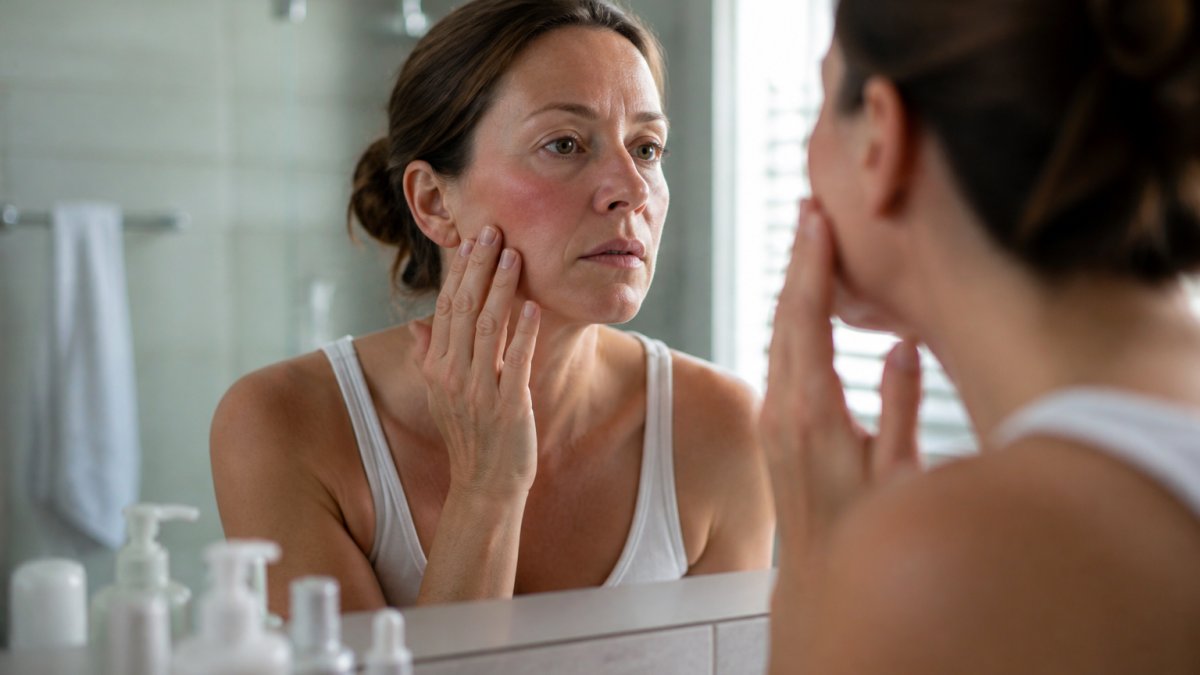
Here is what is happening underneath:
- Thinning of the outer layer while new cells push up from below, which leaves skin temporarily more exposed
- Reduced lipid barrier function, so moisture escapes and irritants get in more easily
- Increased photosensitivity, meaning sun exposure does more damage than it normally would
- Micro-inflammation that shows up as persistent redness rather than a one-day flush
Many users find the adjustment period never fully ends. They simply learn to live at a lower dose, which also means living with weaker results. If your skin is already reactive, that is a bad bargain.
Benefits of Copper Peptides for Aging Skin
The benefits of copper peptides for aging come down to repair rather than controlled damage. Copper peptides, particularly GHK-Cu, are small protein fragments that bind copper ions and support the skin's own rebuilding processes. Rather than forcing turnover, they signal the skin to do what it already knows how to do, just more efficiently.
What that looks like in practice:
- Support for collagen production and skin elasticity over time
- Improved appearance of firmness and smoothness
- Help with skin texture and the look of fine lines and wrinkles
- Compatibility with a damaged barrier, since they do not require peeling to work
They also pair well with hydrating ingredients such as hyaluronic acid, which is one reason a copper peptide serum can act as an all-in-one step instead of a stack of separate products.
How to Repair a Damaged Skin Barrier After Retinol
The fastest way to repair a damaged skin barrier is to stop the irritant, simplify your routine to gentle cleansing and barrier-supporting hydration, and give the skin several weeks to rebuild. There is no shortcut, but the sequence matters more than the products.
- Stop all retinoids, exfoliating acids, and scrubs immediately
- Switch to a fragrance-free, non-foaming cleanser
- Apply a ceramide or hyaluronic acid moisturizer morning and night
- Add a broad-spectrum sunscreen and reapply during the day (the American Academy of Dermatology)
- Pause vitamin C serums and any other active ingredients until redness fades
- Reintroduce one product at a time, with at least a week between additions
Most people see noticeable improvement in barrier comfort within two to four weeks of this routine. What they often do not realize is that the repair phase is the ideal moment to switch strategies entirely, rather than waiting to restart the same cycle.
Comparing Retinol and Retinol Alternatives
Retinol and its alternatives differ at the receptor level, not just in strength. Retinol converts to retinoic acid in the skin, which then binds retinoic acid receptors (RARs) and forces accelerated epidermal turnover. Alternatives such as bakuchiol, copper peptides, and other botanicals do not bind RARs at all, they work through separate pathways, which is why they do not trigger the same irritation cascade.
That mechanistic difference explains every practical trade-off that follows.
| Factor | Retinol | Bakuchiol | Copper Peptides (GHK-Cu) | Peptides (Matrixyl-type) |
|---|---|---|---|---|
| Primary mechanism | RAR binding, accelerated turnover | Antioxidant and retinol-like gene expression without RAR binding | Copper-ion signaling for collagen and repair | Signal peptides that mimic collagen fragments |
| Adjustment period | 2-4 weeks of retinization | Minimal | Minimal to none | None |
| Photosensitivity | Increased | Not typically increased | Not typically increased | Not typically increased |
| Barrier impact | Can compromise lipid barrier | Generally well tolerated | Compatible with barrier repair | Compatible |
| Evidence base | Decades of clinical use | Smaller but growing clinical data | Established wound-healing and collagen research | Established collagen-stimulation research |
| Best for | Tolerant, non-reactive skin | Sensitive skin wanting retinol-like effects | Aging skin needing firmness support | Early fine lines, prevention |
| Layering difficulty | High, conflicts with acids | Low | Low | Low |
A few specifics worth knowing before you choose:
- Bakuchiol is the closest functional analog to retinol in consumer perception, but its clinical evidence base is smaller. Most studies compare it to retinol over 12 weeks and find comparable improvement in fine lines and hyperpigmentation with significantly less stinging and flaking. It is not a weaker retinol, it is a different molecule with a different safety profile.
- Copper peptides work through copper-ion delivery to fibroblasts, supporting collagen and elastin production. They are not turnover agents, so they will not resurface texture the way a retinoid does. What they do well is firmness, elasticity, and barrier-compatible repair.
- Signal peptides (often labeled as Matrixyl, palmitoyl tripeptide-1, or palmitoyl tetrapeptide-7) act as messengers that tell skin to produce more collagen. They are cumulative, not exfoliating, and pair cleanly with almost everything.
The pattern holds: retinol wins on raw potency and evidence volume, alternatives win on consistency and tolerability. Consistency is what produces visible change over months, not weeks, and a product you can actually use nightly beats a stronger one you abandon after ten days.
Transitioning to Retinol Alternatives: A Step-by-Step Protocol
Most guides tell you to just stop retinol and start something else.
Step 1: Reduce frequency first. Cut retinol to twice a week for two weeks, then once a week for two more.
Step 4: Add supporting hydration. A hyaluronic acid layer under your serum helps maintain skin barrier integrity during the switch.
Step 5: Hold the routine for eight weeks. Cellular regeneration is slow. Judging a new active before two months is guessing.
For a simplified approach, a single serum that combines copper peptides with hydrating ingredients removes most of the layering guesswork. Our VAMPIRE TX FACE SERUM pairs Copper Peptides (GHK-Cu), Hyaluronic Acid, and Bee Venom in one step at $19.00, which is the practical version of this protocol for anyone who does not want a five-bottle shelf.
Cost, Sustainability, and Synergistic Layering
Three things rarely get discussed in retinol comparisons: what the routine actually costs to maintain, how the ingredients behave together, and what happens to the bottles you abandon. All three matter more than most people expect, and the third is where the real waste hides.
The cost math most guides skip
A retinoid routine rarely stays a one-product routine. The common pattern is a retinoid, a barrier cream to survive the retinization phase, a gentle cleanser, and often a prescription-strength option to push past tolerance limits.
The sunk-cost problem is the part nobody names: when a retinol product causes irritation, most people do not return it, they shelve it and buy something else. That abandoned bottle is the most expensive product in the routine, because you paid for it and got nothing.
Synergistic layering: what actually pairs with what
This is the gap most guides leave open. Retinol alternatives are not all interchangeable, and they do not all layer the same way with AHAs, BHAs, and vitamin C.
- Bakuchiol + AHAs/BHAs: Generally compatible. Bakuchiol does not increase photosensitivity the way retinol does, so a glycolic or salicylic acid step on alternate nights is usually tolerated. Introduce one at a time.
- Copper peptides + AHAs/BHAs: Avoid same-layer application. Acids can destabilize the copper-peptide complex and reduce its effectiveness. Use them on separate nights, or apply the acid first, wait, then apply the peptide.
- Copper peptides + vitamin C: Traditionally discouraged in the same layer because of pH and oxidation concerns. The practical workaround is timing, vitamin C in the morning, copper peptides at night.
- Signal peptides + almost anything: The most flexible category. They layer cleanly under moisturizer and alongside most actives.
- Niacinamide: Pairs well with all three alternative categories and supports barrier function, which makes it a useful bridge ingredient during a transition.
Order of application still matters:
- Hydration first: hyaluronic acid on damp skin, then seal
- Peptides next: copper peptides work best without competing acids in the same layer
- Antioxidants in the morning: vitamin C or botanical extracts under sunscreen
- Sunscreen last, always: non-negotiable regardless of which active you use
Sustainability is a repurchase-frequency story
Sustainability in skincare is usually framed as ingredient sourcing, but for anyone switching away from retinol, the bigger lever is packaging and repurchase frequency. Fewer products mean fewer bottles, less shipping weight, and less waste from formulas you abandoned halfway through because they irritated your skin. A single well-tolerated serum that lasts a full routine cycle does more for waste reduction than a shelf of half-used bottles, and it does more for your barrier, too.
The cheapest, most sustainable routine is the one you finish. Tolerance beats potency when the goal is visible change over six months, not six days.
Conclusion
The hardest part of leaving retinol behind is not finding a replacement. It is trusting that a gentler ingredient will eventually deliver comparable results, and giving it the eight weeks it needs to prove it.
At Vampire Tx, we built our serum around that reality. The VAMPIRE TX FACE SERUM fuses Copper Peptides (GHK-Cu), Hyaluronic Acid, and Bee Venom into one all-in-one step, so you get high-performance cellular repair without stacking four products or paying luxury markup.
Shop now and give your skin the version of anti-aging that does not require recovery days.
Frequently Asked Questions
What is the best natural alternative to retinol?
Bakuchiol and copper peptides are two of the most researched options. Bakuchiol is a botanical extract that supports cell turnover without triggering the retinoid receptors that cause irritation. Copper peptides, like GHK-Cu, support collagen production and skin barrier integrity. Vampire Tx Face Serum combines copper peptides with bee venom and hyaluronic acid for a non-irritating, all-in-one approach to anti-aging.
Why do dermatologists recommend retinol alternatives for sensitive skin?
Retinol speeds up cell turnover, which can strip the lipid barrier and cause redness, peeling, and photosensitivity, especially in people with sensitive or acne-prone skin. Alternatives such as peptides and botanical extracts support collagen production and skin elasticity without that epidermal irritation. Many dermatologist-recommended formulas focus on barrier repair first, which is why they work better for reactive skin types.
Can you get the same anti-aging results from retinol alternatives?
For fine lines, wrinkles, and skin texture, research on ingredients like copper peptides shows measurable improvement in firmness and dermal thickness over 8 to 12 weeks. They may not match prescription retinoids for severe photoaging, but for prevention and mild to moderate signs of aging, alternatives offer a gentler path with fewer side effects and better consistency for daily use.
How do retinol alternatives fit into a routine with other active ingredients?
Layer alternatives with hydrating and barrier-supporting ingredients like hyaluronic acid and ceramides. Apply your peptide serum first on clean skin, follow with moisturizer, and use sunscreen every morning. Avoid combining with strong exfoliating acids on the same day at first. This synergistic layering protects the skin microbiome and lets each active ingredient do its job without overload.