
Table of Contents
- Bee Venom vs Retinol: How the Two Compare
- Bee Venom vs Retinol: Key Differences at a Glance
- Copper Peptides and Bee Venom Benefits for Fine Lines
- Bee Venom vs Retinol Side Effects and Skin Sensitivity
- Is Bee Venom Safe for Daily Use?
- How to Choose: Long-Term vs Short-Term Results and Ethical Sourcing
- Conclusion: Which Ingredient Belongs in Your Routine?
- Frequently Asked Questions
Last Updated: September 13, 2026
Bee Venom vs Retinol: How the Two Compare
If you've ever typed "is bee venom better than retinol" into a search bar at midnight, you're not alone. This is the question at the center of the biggest shift in anti-aging skincare right now: the move away from harsh, single-ingredient actives toward formulas that do more than one job. Below, we break down how each ingredient works, who should avoid which, and how to layer them without wrecking your skin barrier.
What Is Bee Venom in Skincare?
Bee venom is a bioactive compound harvested from honeybees and used in topical skincare to create a controlled micro-stimulation of the skin. It contains melittin, a peptide that triggers a mild inflammation response, which in turn encourages epidermal stimulation and increased blood flow to the surface. The result is a temporary plumping effect and, with consistent use, improved appearance of firmness and skin texture. It's the same principle behind the "bee sting facial," just delivered in a serum formulation rather than a live sting.
How Does Retinol Work?
Retinol is a vitamin A derivative, part of the retinoids family, and it works by accelerating cellular turnover. When applied topically, it speeds up the rate at which old skin cells shed and new ones surface, which smooths skin texture and fades the look of photoaging over time. It also supports collagen synthesis deeper in the dermal matrix. The trade-off is well documented: redness, flaking, and a multi-week adjustment period are common, which is why so many people quit before they see results.
Bee Venom vs Retinol: Key Differences at a Glance
Bee venom and retinol target aging through completely different routes: bee venom stimulates surface-level circulation and plumping, while retinol rebuilds skin from the cellular level down. Neither is universally "better." Bee venom suits people who want visible firmness without irritation; retinol suits people willing to tolerate an adjustment period for deeper, longer-term structural change. Here's how they stack up side by side.
| Factor | Bee Venom | Retinol |
|---|---|---|
| Primary action | Circulation and plumping | Cellular turnover |
| Speed of visible results | Days to weeks | 8-12 weeks |
| Irritation potential | Low to moderate | Moderate to high |
| Adjustment period | Minimal | 2-6 weeks |
| Sun sensitivity | Low | Increased |
| Best for | Sensitivity, fine lines | Deep wrinkles, texture |
| Layering conflicts | Few | Many |
Mechanism of Action: Collagen Production and Cellular Turnover
Retinol has the stronger direct evidence for collagen synthesis. It's the dermatologist-recommended gold standard for wrinkle reduction because decades of clinical trials support its effect on the dermal matrix. Bee venom works more indirectly: melittin triggers an inflammation response that signals the skin to repair itself, which supports collagen production as a downstream effect rather than a direct one. In practice, this means retinol tends to deliver more dramatic long-term structural change, while bee venom delivers faster visible plumping with far less disruption to your skin barrier.
Copper Peptides and Bee Venom Benefits for Fine Lines
Copper peptides and bee venom benefits compound each other in a way single-ingredient actives can't. Copper peptides (GHK-Cu) support the skin's own repair signaling, while bee venom drives circulation and surface-level firmness. Together they address fine lines from two directions: peptide profile support underneath, visible plumping on top. This is why we build our serum around that pairing rather than bee venom alone. For early fine lines around the eyes and mouth, this combination can show visible improvement faster than retinol, which often makes things look worse before they look better.
Is Bee Venom Scientifically Proven?
Bee venom has far less clinical backing than retinol, and anyone claiming otherwise is overselling it. The research on melittin and skin rejuvenation exists but is smaller in scale than the retinoid literature, which spans decades of dermatological efficacy studies. What bee venom does have going for it is a strong safety profile in cosmetic use and a low irritation potential compared to retinoids. Treat it as a well-tolerated, evidence-supported cosmetic ingredient, not a pharmaceutical-grade active. Retinol remains the more rigorously proven option for wrinkle reduction specifically.
Bee Venom vs Retinol Side Effects and Skin Sensitivity
The first month is where these two ingredients diverge most sharply, and it's also where most people quit the wrong one.
Retinol's expected reactions. Redness, tightness, flaking, and a temporary purge of underlying congestion are normal in the first two to six weeks. The purge happens because accelerated turnover pushes existing clogs to the surface faster. It is not a sign the product is wrong for you; it is a sign the mechanism is working. Most practitioners recommend starting at two nights per week and building slowly, buffering with moisturizer if needed, and never skipping daily sunscreen because retinol reduces the skin's UV tolerance.
Bee venom's reactions. Bee venom is generally well tolerated, but it contains melittin, which is the same compound responsible for the pain and swelling of a bee sting. In people without a sting allergy, the typical response is a brief warming or tingling sensation that fades within minutes. In people with a sting allergy, the response can escalate to itching, hives, swelling, or in rare cases a systemic reaction (the CDC). This is not a theoretical risk, and it is the single most important safety distinction between the two ingredients.
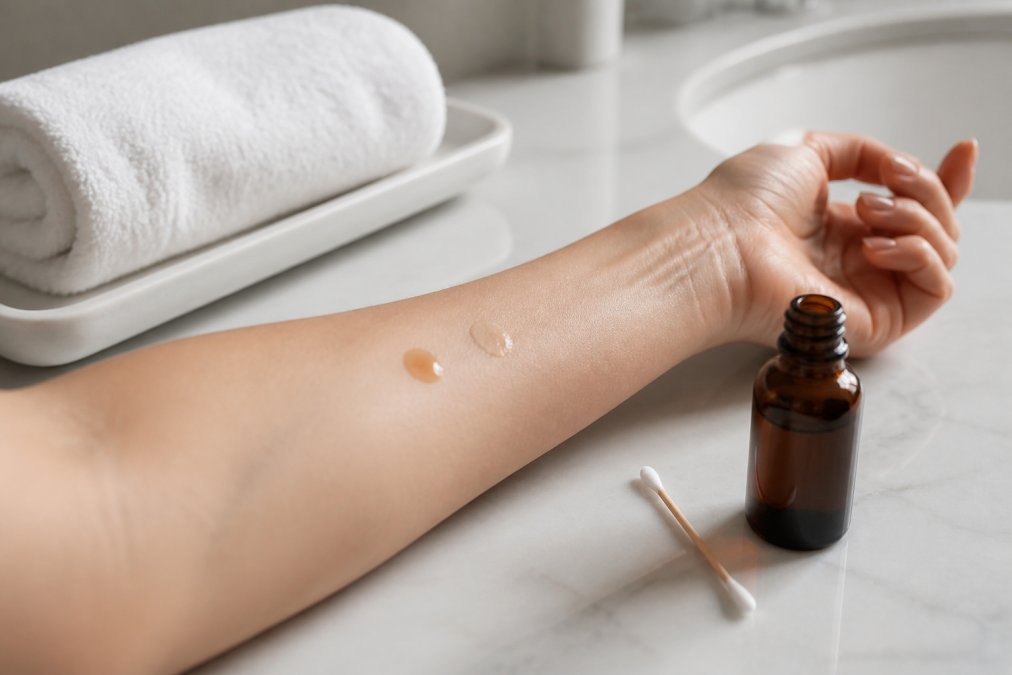
Allergy Testing Protocols and Patch Test Steps
If you have ever had a systemic reaction to a bee sting, do not use bee venom products. That is a hard stop, not a caution. If you have only had mild local reactions or no known allergy, follow this protocol before your first full-face application:
- Apply a small amount of product to the inner forearm
- Leave it uncovered for 24 hours
- Check for redness, swelling, itching, or hives
- If clear, repeat on a small area behind the ear
- Wait another 24 hours before applying to the full face
- Stop immediately and consult a physician if any swelling, hives, or breathing changes occur
Keep a written note of the date and result. If you introduce other new products in the same window, you won't be able to tell which one caused a reaction.
Can You Use Bee Venom and Retinol Together?
Yes, but not in the same layer. The two ingredients don't chemically cancel each other out, but stacking them increases the chance of irritation because retinol is already stressing the barrier. The practical approach most people land on:
- Morning: bee venom serum, then moisturizer, then sunscreen.
- Night: retinol on its own, buffered with moisturizer if your skin is reactive.
- Alternate nights if you're new to retinol or have sensitive skin.
- Avoid pairing retinol with AHAs, BHAs, or high-concentration vitamin C in the same routine. Bee venom layers fine with all three.
If you're transitioning off retinol because of irritation, don't quit cold turkey and jump straight into a full bee venom routine. Cut retinol to twice a week for two weeks while you introduce the new serum, then drop the retinol entirely. Your barrier will thank you.
Is Bee Venom Safe for Daily Use?
Bee venom is safe for daily use in most people once a patch test clears, and it doesn't carry the sun-sensitivity penalty that makes daily retinol use complicated. You can apply a bee venom serum morning and night without the same cumulative irritation risk. Retinol, by contrast, is usually cycled: two to three nights a week to start, building up slowly, and always paired with daily sunscreen because it thins the skin's UV defenses. If you want a routine you don't have to think about, bee venom wins on simplicity.
Layering and Chemical Compatibility with Retinol and Acids
Bee venom plays well with almost everything, which is not true of retinol. You can layer a bee venom serum with vitamin C, hyaluronic acid, and most moisturizers without conflict. Retinol is pickier: it clashes with AHAs, BHAs, and high-concentration vitamin C, and stacking it with acids in the same routine often triggers irritation. If you want both ingredients, use retinol at night and bee venom in the morning, or alternate nights. Never apply them in the same layer.
How to Choose: Long-Term vs Short-Term Results and Ethical Sourcing
Choose retinol if your priority is deep wrinkle reduction and you'll commit to the adjustment period and daily sunscreen. Choose bee venom if you want visible firmness and plumping without the irritation, sun sensitivity, or layering headaches. On the ethics side, look for suppliers who use humane harvesting methods and can speak to their sourcing, since bee venom collection practices vary widely and "sustainable" gets used loosely. Ask brands directly how their venom is collected; the ones doing it right will answer without hesitation.
Conclusion: Which Ingredient Belongs in Your Routine?
The real challenge isn't picking a winner between bee venom and retinol. It's finding a routine you'll actually stick to, one that delivers visible results without turning your skin into a flaky, irritated mess. That's exactly the problem Vampire Tx was built to solve. Our Vampire Tx Face Serum fuses copper peptides (GHK-Cu), hyaluronic acid, and bee venom into a single all-in-one formula for firmness, smoothness, and hydration, at $19 with no luxury markup. If you'd rather stock up, the two-bottle set runs $35 and the three-bottle set runs $49. Get started with Vampire Tx and build the simplified, high-performance routine your skin has been waiting for.


Frequently Asked Questions
Does bee venom really help saggy skin?
Bee venom contains melittin, a bioactive compound that triggers a controlled inflammation response and temporary micro-swelling, which can create a short-term plumping effect. It may also support collagen synthesis over time, but clinical trials on saggy skin are limited compared with retinoids. For visible firmness, a formula that pairs bee venom with copper peptides offers more support because copper peptides help rebuild the dermal matrix. Expect gradual improvement in skin texture rather than an instant lift.
Is bee venom safe for daily use?
Bee venom is safe for daily use in most people when it is formulated at cosmetic concentrations. Start with once-daily application at night, and always perform a patch test on your inner forearm 24 hours before full-face use. If you have a known bee sting allergy, avoid bee venom entirely. People with sensitive or reactive skin should introduce it slowly, every other day for the first week, then build up. Stop use if you notice persistent redness, swelling, or irritation.
What are the side effects of bee venom vs retinol?
Retinol commonly causes dryness, peeling, redness, and sun sensitivity, especially in the first weeks of use. Bee venom side effects are usually milder: temporary tingling, warmth, or slight redness at application. The bigger risk with bee venom is an allergic reaction, which is why a patch test matters. Retinol also makes skin more vulnerable to UV damage, so daily sunscreen is non-negotiable. Bee venom does not increase sun sensitivity, making it easier to layer into a morning or evening routine.
Can I use bee venom with retinol in the same routine?
Yes, but timing matters. Retinol and bee venom can be used together if you alternate nights or apply bee venom in the morning and retinol at night. Avoid layering bee venom directly over strong acids like glycolic or salicylic acid, because the combination can overwhelm the skin barrier. If your skin is sensitive, use bee venom on recovery nights between retinol applications. A serum that combines bee venom with copper peptides and hyaluronic acid can simplify this step and reduce irritation risk.
How long until I see results from bee venom compared to retinol?
Bee venom can produce a temporary plumping effect within minutes to hours, which helps fine lines look smoother short-term. Retinol takes longer, often 8 to 12 weeks, to show measurable wrinkle reduction because it works by accelerating cellular turnover. For long-term anti-aging, retinol has more clinical backing, but bee venom paired with copper peptides supports collagen and skin barrier health over time. Many people use both: bee venom for daily hydration and firmness, retinol for deeper structural change.