
Table of Contents
- What Are Copper Peptides and Bee Venom?
- Copper Peptides vs Bee Venom: How They Work
- Benefits for Aging Skin: Wrinkle Reduction and Firmness
- Bee Venom Serum Side Effects and Safety
- How to Layer Copper Peptides with Other Actives
- Best Copper Peptide Serum for Aging: What to Look For
- Frequently Asked Questions
Last Updated: September 10, 2026
What Are Copper Peptides and Bee Venom?
Copper peptides vs bee venom for skin is a comparison worth understanding before you buy either. Both target visible aging through completely different mechanisms. This guide from Vampire Tx breaks down how each performs so you can decide which belongs in your routine, or whether you need both.

Copper peptides are short chains of amino acids bound to a copper ion, most commonly GHK-Cu. They support collagen synthesis, elastin production, and skin barrier repair at the cellular level.
Bee venom is a complex mixture harvested from honeybees, with melittin as its most studied compound. It creates a controlled micro-stimulation on the skin surface that temporarily firms and smooths the appearance of fine lines.
Copper Peptides: GHK-Cu and Collagen Synthesis
GHK-Cu is the best-known copper peptide in skincare and has the deepest research history. The peptide chain binds copper and delivers it into the skin, where it participates in tissue regeneration and dermal remodeling.
In practice, copper peptides support the skin's own repair processes: they encourage collagen and elastin production, calm inflammation, and support barrier repair. Results build cumulatively with consistent use rather than appearing overnight.
Bee Venom: Melittin and Skin Firming
Melittin is the compound behind bee venom's cosmetic reputation. Applied topically in controlled amounts, it creates a mild stimulation response that increases surface blood flow and temporarily tightens skin.
It is often compared to a gentle neurotoxin alternative, though that oversells it, bee venom does not paralyze muscles. It plumps and firms the surface for a period after application, making it popular for events, photos, and mornings when you want a visible lift.
Copper Peptides vs Bee Venom: How They Work
These two ingredients operate on entirely different timelines, the single most important thing to understand about the comparison.
Copper peptides work below the surface, influencing collagen synthesis, elastin production, and cellular renewal, so their payoff is measured in weeks and months. Bee venom works at the surface: its firming effect is visible quickly and fades as the product wears off.
| Feature | Copper Peptides | Bee Venom |
|---|---|---|
| Primary action | Collagen and elastin support | Surface firming and lift |
| Speed of visible results | Weeks to months | Minutes to hours |
| Effect duration | Cumulative | Temporary |
| Key compound | GHK-Cu | Melittin |
| Best for | Long-term anti-aging | Instant smoothing |
Because the mechanisms do not overlap or compete, layering them is a reasonable strategy rather than a redundant one. One rebuilds, the other refines. For a deeper look at how these peptides function in skin, the NIH research on GHK-Cu and wound repair is a useful starting point.
Benefits for Aging Skin: Wrinkle Reduction and Firmness
Aging skin loses collagen density, elasticity, and moisture retention at once, producing fine lines, a sagging jawline, and dull texture. Each ingredient addresses a different part of that picture.
Copper peptides target the structural side. Consistent use supports skin firmness and smoother texture by encouraging the skin's own collagen and elastin production. Bee venom targets the visible side, delivering a temporary tightening effect that smooths the look of fine lines within minutes.
The honest trade-off: bee venom gives the instant result, copper peptides the durable one. If you want to see something in the mirror today, bee venom delivers; if you want your skin to look better in six months, copper peptides do the heavier lifting.
Bee Venom Serum Side Effects and Safety
The most common bee venom serum side effects are temporary redness, warmth, and mild tingling that peaks 10 to 15 minutes after application and fades within an hour. These reactions are expected. What separates a normal response from a problem is intensity, duration, and whether the reaction spreads beyond the application site.
That said, bee venom is not for everyone. Anyone with a known bee or honeybee allergy should avoid it entirely. Melittin is the same compound responsible for the pain and systemic response of a live sting, and a sensitized person can react to topical exposure even at cosmetic concentrations. If you have ever carried an epinephrine auto-injector, needed medical care after a sting, or reacted to honey or bee pollen with more than mild local irritation, skip bee venom products.
A Step-by-Step Patch Testing Protocol
Here is the patch testing protocol dermatology offices actually use, adapted for at-home use:
- Choose the right site. The inner forearm is standard. Behind the ear is commonly suggested, but that skin is thinner and more reactive, producing more false positives.
- Test the product, not the ingredient. Apply a pea-sized amount of the exact finished serum you plan to use, not a diluted drop or a swatch from a tester. Formulation excipients can trigger reactions too.
- Wait 24 hours, then reapply. If there is no reaction at 24 hours, apply again and check at 48. Delayed hypersensitivity to melittin can take two full days to surface, so a single 24-hour check is not enough.
- Grade what you see. Mild pinkness that fades within an hour is a normal response. Raised, itchy welts, spreading redness, or swelling beyond the test site are not, discontinue use.
- Do a half-face test before full-face use. If the forearm test is clean, apply to one cheek for three consecutive days before committing to your whole face, catching reactions that only appear with repeated exposure.
Sensitive Skin and Starting Dosage
Sensitive skin should start slowly regardless of patch test results. A common mistake is applying a full dose on day one and reading the resulting flush as damage. Most people adjust within a week of every-other-day use, building to daily application only once the tingling shortens to a few minutes.
If you already use exfoliating acids, retinoids, or prescription topicals, introduce bee venom on an off-night from those actives. Barrier disruption amplifies the melittin response and makes it harder to tell which ingredient is causing irritation.
Who Should Not Use Bee Venom
- Anyone with a documented bee, wasp, or honeybee sting allergy
- People with a history of anaphylaxis to any insect venom
- Those currently using prescription retinoids or undergoing professional chemical peels, until the barrier has recovered
- Anyone who has reacted to bee-derived ingredients like propolis, royal jelly, or bee pollen
For everyone else, the risk profile is low and the tingling is expected. The point of testing is not to avoid the sensation but to confirm your immune system is not mounting a response beyond it.
How to Layer Copper Peptides with Other Actives
Layering copper peptides with other actives works best when you apply thinnest to thickest, keep conflicting ingredients apart, and respect each ingredient's pH. Order matters, but timing windows matter more, and that is where most routines quietly fail.
A simple, effective sequence:
- Cleanse and pat dry.
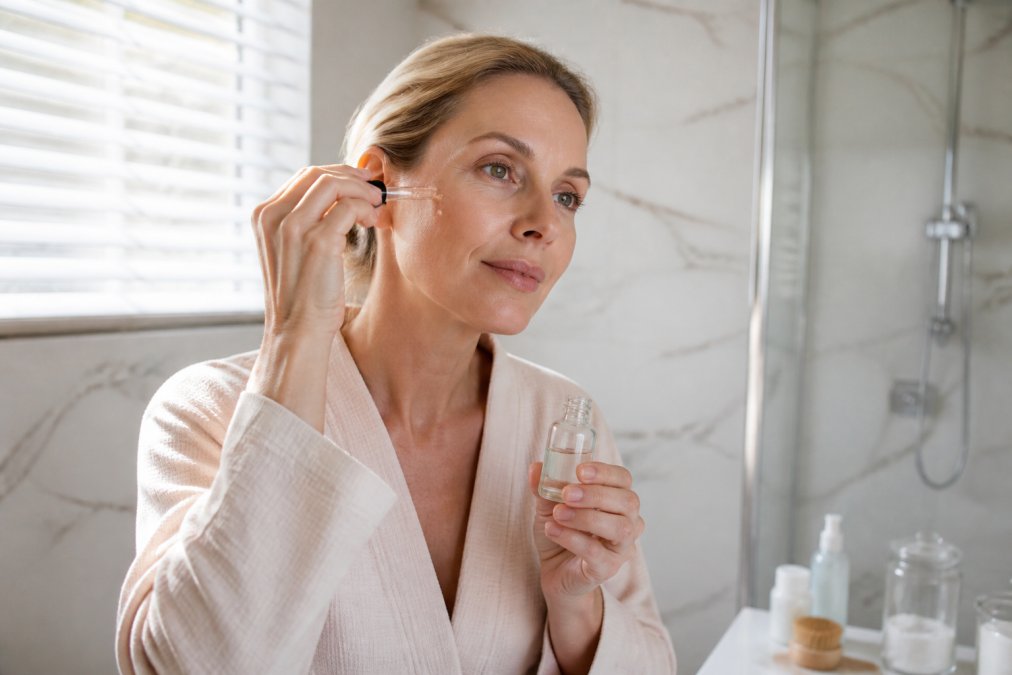
- Apply a copper peptide serum to damp skin and let it absorb for 60 to 90 seconds.
- Follow with a bee venom product if you are using both.
- Seal with moisturizer.
- Finish with sunscreen in the morning.
The Interaction Question: Do They Cancel Each Other Out?
This is the most-asked and least-answered question about copper peptides, and the honest answer is that the science is not settled. What is known: GHK-Cu needs its copper ion intact to signal collagen synthesis, and ingredients that chelate copper, grab and hold metal ions, can strip it away, leaving an inert peptide chain.
The main culprits are:
- L-ascorbic acid (vitamin C): At low pH, ascorbic acid is a strong copper chelator. Applying it in the same step as copper peptides is the classic antagonistic pairing.
- Strong acids (glycolic, lactic, salicylic): These lower skin pH below the range where GHK-Cu is stable, and the acidic environment accelerates peptide breakdown.
- Retinoids: Not a direct chelator, but the irritation and barrier turnover they cause can reduce how well the peptide absorbs and how consistently you can use it.
- Benzoyl peroxide: Oxidizing agents degrade peptides on contact.
Bee venom does not chelate copper or operate at a pH that destabilizes GHK-Cu, so the pairing is generally considered compatible. Surface micro-stimulation and dermal remodeling do not compete for the same receptors or skin layer.
Timing Windows That Actually Work
If you use any of the antagonistic actives above, separate them by time of day rather than trying to buffer them in the same routine:
- Morning: Vitamin C, acids, or benzoyl peroxide, whichever you use, followed by moisturizer and sunscreen.
- Evening: Copper peptides first, then bee venom if you use it, then moisturizer.
- Retinoid nights: Apply the retinoid on its own, and move copper peptides to the alternate night. Do not stack them.
A common pattern: copper peptides five nights a week, a retinoid two nights a week, preserving the cumulative collagen benefit without forcing both onto a barrier that is already turning over.
What About Bee Venom and Copper Peptides Together?
Because bee venom works at the surface and copper peptides below it, there is no mechanistic reason they would interfere. The caveat is sensory, not chemical: bee venom's tingling can make it hard to tell whether a new copper peptide serum is causing irritation. If introducing both, stagger them by a week so you can attribute any reaction correctly.
The American Academy of Dermatology guidance on building a skincare routine recommends introducing one new active at a time so you can identify what is actually working, and that advice applies directly here. For the peptide side of the equation, the NIH research on GHK-Cu and wound repair is a useful starting point on why copper binding matters to the mechanism.
Best Copper Peptide Serum for Aging: What to Look For
The best copper peptide serum for aging lists GHK-Cu clearly, pairs it with hydrating ingredients, and does not hide behind vague "peptide blend" language. Concentration transparency matters: a peptide near the bottom of an ingredient list is unlikely to do much.
Four things to check before buying:
- Named peptide: Look for GHK-Cu specifically, not a generic "copper peptide complex."
- Supporting ingredients: Hyaluronic acid and similar humectants help the peptide absorb and keep skin comfortable.
- Packaging: Copper peptides are sensitive to light and air. Opaque or airless packaging protects the formula.
- Price versus formula: A high price does not guarantee a better peptide. Many costlier serums use the same actives with a larger marketing budget.
That last point is where most shoppers overspend. Copper peptides are not rare or expensive to source. You are paying for formulation quality, not exclusivity.
This is exactly the gap Vampire Tx was built to close. The Vampire Tx Face Serum combines copper peptides (GHK-Cu), hyaluronic acid, and bee venom in one formula at $19, so you get both mechanisms without stacking two separate products or paying a luxury markup. If you want to commit to a routine, the two-bottle set runs $35 and the three-bottle set runs $49.


Frequently Asked Questions
Can copper peptides and bee venom be used in the same routine?
Yes. Layering copper peptides bee venom in one routine is safe for most people because they work through different pathways. Copper peptides support collagen synthesis and skin barrier repair, while bee venom creates a temporary firming effect through increased circulation. Apply the thinner formula first, wait one to two minutes, then follow with the thicker one. A single serum that already combines both, like Vampire TX Face Serum, removes the guesswork entirely.
Does bee venom work on saggy skin?
Bee venom creates a temporary tightening effect by boosting blood flow and stimulating the skin, which can make a sagging jawline look firmer for hours. It does not rebuild lost volume or permanently lift tissue. For longer-term improvement in skin firmness, copper peptides and their effect on collagen synthesis matter more. Most users see the best results combining both: instant firming from bee venom, gradual structural support from copper peptides over 8 to 12 weeks.
What ingredients should you avoid pairing with copper peptides?
Skip strong acids like glycolic and salicylic acid, high-dose vitamin C (L-ascorbic acid), and benzoyl peroxide in the same step as copper peptides. These can destabilize the peptide chains or cause irritation that cancels out the repair benefits. If you use them, separate them by 30 minutes or apply acids in the morning and copper peptides at night. Retinol is fine when alternated on different evenings.
Is bee venom safe for those with sensitive skin?
Most people tolerate bee venom serums well, but anyone with a known bee sting allergy should avoid them. Sensitive skin types should patch test on the inner forearm for 24 hours before applying to the face. Start with every other day for the first week. Signs of a reaction include persistent redness, swelling, or itching that lasts beyond 30 minutes. If those appear, stop use and consult a dermatologist.
Deep wrinkles and a sagging jawline are stubborn, and no single ingredient reverses them overnight. What works is consistency with ingredients that address both the structure and the surface of your skin. Vampire Tx combines copper peptides, hyaluronic acid, and bee venom in one serum so you get cumulative collagen support and immediate firming without building a multi-step routine or paying luxury prices. Get started with Vampire Tx and lock your skin in its prime.