
Table of Contents
- What Are Copper Peptides and How Do They Work on Skin?
- Copper Peptides Benefits for Wrinkles: What the Science Shows
- Copper Peptides vs Retinol: Which One Wins for Aging Skin?
- What Not to Mix with Copper Peptides (Ingredient Incompatibility Guide)
- How to Use Copper Peptides in Your Skincare Routine
- Long-Term Efficacy Timeline: When to Expect Real Results
- Potential Side Effects and Safety Considerations
- Copper Peptides Benefits for Wrinkles: Final Verdict
- Frequently Asked Questions
Last Updated: September 2, 2026
What Are Copper Peptides and How Do They Work on Skin?
Copper peptides are small protein fragments that bind to copper ions, creating a complex the skin readily absorbs and uses at the cellular level. They interact directly with fibroblasts in the dermis, the cells responsible for producing collagen and elastin, rather than delivering only surface-level results.
When copper peptides reach the dermis, they activate fibroblast activity, promote dermal remodeling, and suppress collagenases, the enzymes that break down existing collagen. By modulating collagenase activity while stimulating new collagen synthesis, copper peptides work on both ends of the aging equation. They also accelerate cellular turnover and support skin barrier function, improving surface texture alongside deeper structural changes.
GHK-Cu: The Active Form That Drives Results
GHK-Cu (glycyl-L-histidyl-L-lysine copper) is the specific copper peptide complex responsible for virtually all dermatological efficacy in this ingredient class. It occurs naturally in human plasma, saliva, and urine, with concentrations declining significantly after the mid-30s, aligning with progressive skin quality deterioration.
As documented in National Institutes of Health research on GHK-Cu and skin biology, GHK-Cu stimulates collagen synthesis, improves skin elasticity, and promotes wound healing. In topical application, its bioavailability depends on serum formulation and concentration, making delivery vehicle as important as the ingredient itself.
Copper Peptides Benefits for Wrinkles: What the Science Shows
Copper peptides benefits for wrinkles stem from three interconnected processes: collagen synthesis, elastin production, and antioxidant defense against photoaging.
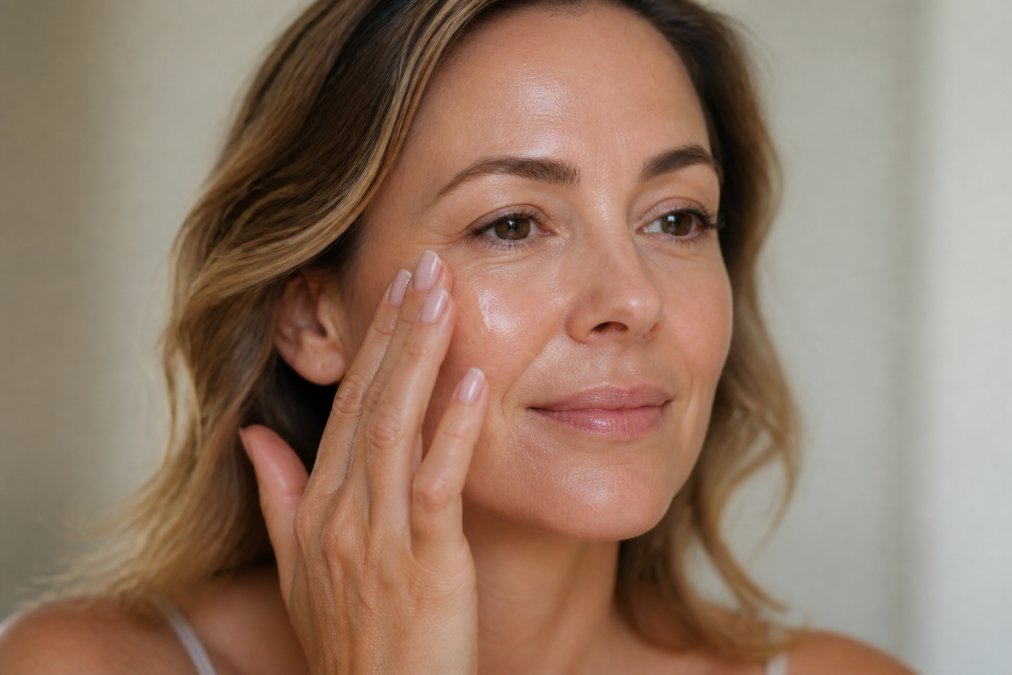
Peer-reviewed research on GHK-Cu demonstrates measurable improvements in skin firmness, texture, and fine line depth following consistent topical application over 8-12 weeks. Results reflect actual changes in dermal architecture rather than temporary surface hydration.
Collagen and Elastin Production
Fibroblasts require copper as a cofactor for enzymes that cross-link collagen and elastin fibers. GHK-Cu delivers bioavailable copper directly to fibroblasts, supporting the complete collagen synthesis pathway from initial fiber formation through cross-linking and integration into the extracellular matrix. This creates denser, more organized dermal tissue that resists the mechanical deformation that creates permanent wrinkles.
Elastin production follows a similar pathway. As elastin fibers degrade with age and photoaging, skin loses its rebound quality and wrinkles become more pronounced. Copper peptides support elastin regeneration at the fibroblast level, contributing to measurable improvements in skin elasticity.
Antioxidant Properties and Photoaging Defense
Oxidative stress is a primary driver of photoaging. Free radicals generated by UV radiation damage DNA, degrade collagen, and impair skin barrier function. Copper peptides carry significant antioxidant properties that neutralize these free radicals before they cause structural damage.
According to Journal of Cosmetic Dermatology research on peptide antioxidants, GHK-Cu demonstrates measurable antioxidant activity that complements its pro-collagen effects. This dual role, building new structure while defending against ongoing damage, makes copper peptides particularly valuable for adults dealing with accumulated sun damage.
Copper Peptides vs Retinol: Which One Wins for Aging Skin?
Copper peptides and retinol work differently, and the choice depends less on efficacy and more on skin tolerance.
Retinol accelerates cellular turnover by binding to retinoid receptors, forcing faster cell cycling. This produces visible improvements in texture and fine lines but comes with redness, peeling, and increased sensitivity lasting weeks. For sensitive skin, this adjustment period is genuinely difficult.
Copper peptides produce similar long-term outcomes through a different mechanism. Rather than forcing accelerated turnover, they support the skin's natural regeneration at the fibroblast level. Results build gradually with no adjustment period, peeling, or photosensitivity increase.
| Factor | Copper Peptides | Retinol |
|---|---|---|
| Primary mechanism | Fibroblast activation, collagen synthesis | Cellular turnover acceleration |
| Adjustment period | Minimal to none | 4-8 weeks of irritation common |
| Sun sensitivity | No increase | Significant increase |
| Sensitive skin suitability | Generally well-tolerated | Often problematic |
| Speed of visible results | 8-12 weeks | 4-8 weeks |
| Collagen building | Direct stimulation | Indirect via turnover |
| Combination potential | Pairs well with most actives | Requires careful layering |
For adults over 40 with established wrinkles, retinol's faster results appeal. For sensitive or reactive skin, copper peptides are the stronger choice. Many dermatologists recommend using both at different times, copper peptides in the morning and retinol at night, to capture both mechanisms without conflict.
What Not to Mix with Copper Peptides (Ingredient Incompatibility Guide)
Copper peptides are chemically reactive, and certain combinations reduce efficacy or cause skin irritation.
Critical incompatibilities:
- Vitamin C (ascorbic acid): High-dose ascorbic acid oxidizes copper ions, rendering GHK-Cu inactive. Separate by at least 30 minutes or use at different times of day.
- AHAs and BHAs: Low pH environments destabilize copper peptide complexes. Apply acid exfoliants separately from copper peptide serums.
- Niacinamide (high concentrations): Some formulations show interaction between copper ions and high-dose niacinamide. Lower concentrations are generally fine.
- Retinol (same application time): Not a chemical incompatibility, but both are actives. Layering simultaneously increases irritation risk without proportional benefit.
Use copper peptide serums as a standalone step on clean skin before moisturizer, and separate acidic or oxidizing actives by at least one application window.
How to Use Copper Peptides in Your Skincare Routine
Standard application sequence:
- Cleanse with a gentle, pH-balanced cleanser
- Apply any water-based toner or essence
- Apply copper peptide serum to slightly damp skin
- Allow 60-90 seconds for absorption
- Follow with moisturizer to seal in the serum
- Apply SPF (morning only)
Applying to slightly damp skin improves bioavailability. Twice daily application consistently outperforms once daily, but once daily is adequate for maintenance.
Skin Type Specificity: Adjusting Application by Skin Type
Dry skin: Apply to damp skin and follow immediately with a rich moisturizer. The moisturizer layer is essential for barrier support.
Oily or acne-prone skin: Copper peptides support wound healing and have mild anti-inflammatory properties, making them useful for post-breakout repair. Use a lightweight moisturizer after application.
Sensitive or reactive skin: Start with once daily evening application. Most sensitive skin types tolerate GHK-Cu well within the first week.
Mature skin (50+): Twice daily application paired with hyaluronic acid gives the best results. Mature skin has reduced natural hyaluronic acid production, so combining both addresses structural and hydration deficits. The Vampire Tx face serum pairs GHK-Cu with hyaluronic acid and bee venom in a single step.

Long-Term Efficacy Timeline: When to Expect Real Results
Copper peptides benefits for wrinkles follow a predictable timeline:
Weeks 1-2: No visible change in wrinkles. Skin may feel more hydrated and surface texture can improve slightly.
Weeks 3-6: Early improvements in skin tone and surface smoothness. Fine lines in high-movement areas like crow's feet may appear slightly less pronounced.
Weeks 8-12: Measurable improvements in skin firmness and elasticity. Deeper fine lines show visible softening.
Months 4-6: Continued improvement in texture, tone, and wrinkle depth. Cumulative gains from consistent use become most visible.
Beyond 6 months: Long-term consistent use is associated with sustained improvement and slowing the rate of new wrinkle formation.
Very deep wrinkles caused by decades of sun damage or significant volume loss will not disappear with topical copper peptides alone. Topical application works at the dermis and epidermis level, not deeper structural levels. For those cases, copper peptides serve as a maintenance and enhancement tool.
According to American Academy of Dermatology guidance on anti-aging ingredients, consistent use of evidence-backed topical actives over 12+ weeks is the standard benchmark for evaluating anti-aging ingredient efficacy. Copper peptides meet that standard.
Potential Side Effects and Safety Considerations
Copper peptides have a well-established safety profile for topical application. Unlike retinoids, they carry no formal adjustment period or pregnancy contraindications.
The most commonly reported side effect is mild redness or tingling on first use, particularly in sensitive skin. This typically resolves within the first few applications. Persistent redness warrants discontinuing use and consulting a dermatologist.
Specific considerations:
- Bee venom combinations: Formulas pairing copper peptides with bee venom may cause localized sensitivity in people with bee sting allergies. Consult a physician before use if you have a known bee venom allergy.
- Overuse: Twice daily is the practical ceiling for most formulations. Using multiple copper peptide products simultaneously doesn't improve results.
- Oxidized formulas: Serums that have changed color (typically from clear to brown or orange) have undergone oxidation and should be discarded.
For general safety guidance on topical skincare actives, the FDA guidance on cosmetic ingredient safety provides a useful framework for understanding how over-the-counter skincare products are regulated.
Copper Peptides Benefits for Wrinkles: Final Verdict
Copper peptides benefits for wrinkles are real, well-supported, and distinct from most other anti-aging ingredients. GHK-Cu works at the fibroblast level to stimulate collagen synthesis, support elastin production, and defend against oxidative stress. Results are structural, not cosmetic, and persist rather than wash off.
The case for copper peptides is strongest for:
- Adults 35-65 seeking consistent, long-term anti-aging results
- People with sensitive skin who cannot tolerate retinol
- Anyone looking to simplify their routine without sacrificing active ingredient coverage
- Those dealing with fine lines, crow's feet, and early-to-moderate photoaging
For most adults, copper peptides benefits for wrinkles make a strong argument for including GHK-Cu as a core part of a daily routine. The ingredient's tolerability, dual-action mechanism, and long-term safety profile make it one of the few anti-aging actives worth committing to long-term.
Choosing the right copper peptide serum means finding a formula where GHK-Cu is paired with complementary actives and delivered at an effective concentration. Vampire Tx combines copper peptides, hyaluronic acid, and bee venom in a single serum designed to address firmness, smoothness, and hydration. The two-bottle pack at $35 or three-bottle pack at $49 makes consistent long-term use accessible. Shop now and commit to the timeline the science supports.

Frequently Asked Questions
How often should I apply copper peptides to my face?
Once daily is the standard starting point, applied in the evening after cleansing and before moisturizer. Once your skin adjusts over two to three weeks, twice-daily use (morning and evening) is well tolerated by most skin types. Avoid applying copper peptides at the same time as vitamin C or strong acids, as those combinations can reduce the peptide complex's stability and effectiveness.
Is copper peptide more effective than retinol for wrinkles?
They work differently. Retinol accelerates cellular turnover and is one of the most clinically studied anti-aging ingredients available, but it commonly causes dryness, peeling, and sensitivity, especially during the adjustment period. Copper peptides, specifically GHK-Cu, stimulate collagen synthesis and dermal remodeling without that irritation profile. For sensitive skin, copper peptides are often the better first choice. For deeper photoaging, using both on alternating nights can address multiple mechanisms at once.
What ingredients should I avoid mixing with copper peptides?
Avoid combining copper peptides with vitamin C (ascorbic acid), AHAs like glycolic acid, BHAs like salicylic acid, and retinoids in the same application. Acidic environments destabilize GHK-Cu and can trigger oxidative reactions that reduce its skin regeneration benefits. Use copper peptides in a separate AM or PM step, and apply acids or retinoids at a different time of day or on alternating nights.
How long does it take to see results from copper peptide serums?
Most users notice improved skin texture and hydration within two to four weeks of consistent topical application. Visible reduction in fine lines and crow's feet typically requires eight to twelve weeks, since collagen and elastin production in the dermis takes time to accumulate. Deeper wrinkles may show meaningful improvement after four to six months of daily use. Consistency matters far more than frequency spikes.
Can copper peptides be used on sensitive skin?
Yes, and they are often recommended for sensitive skin precisely because they do not cause the irritation associated with retinoids or exfoliating acids. GHK-Cu has documented anti-inflammatory properties that can actually help calm redness and support skin barrier function. Start with once-daily evening use and patch test on the inner forearm for 48 hours before full facial application. If redness or stinging occurs, reduce frequency and consult a dermatologist.
What are the downsides of copper peptides?
Copper peptides are well tolerated, but a few limitations are worth knowing. They are incompatible with several popular actives, which can complicate layering routines. Results build slowly, which frustrates users expecting fast turnaround. At very high concentrations, excess copper can theoretically promote collagenase activity, which breaks down collagen rather than building it, so formulation quality and concentration matter. Stick to products with validated GHK-Cu concentrations from reputable formulators.
This article was written using GrandRanker