
Table of Contents
- What Is Bee Venom Skincare?
- Potential Benefits for Skin Health
- Bee Venom Side Effects on Skin
- How to Patch Test Bee Venom Products
- Is Bee Venom Safe for Daily Use?
- Bee Venom vs Copper Peptides: Which Is Right for You?
- Who Should Avoid Bee Venom Products?
- Final Verdict on Bee Venom Safety
- Frequently Asked Questions
Last Updated: September 8, 2026
What Is Bee Venom Skincare?
Bee venom skincare uses bee venom as a bioactive ingredient, often marketed as a natural alternative to injectables for wrinkle reduction. The premise is that the venom triggers a mild, localized inflammatory response, which proponents claim stimulates blood flow and collagen production for a temporary plumping effect. Many people searching "is bee venom safe for face" are drawn to this needle-free facelift promise, but the science and safety profile deserve a closer look.
At Vampire Tx, we formulate with bee venom, but safety hinges on concentration, formulation, and individual skin sensitivity. The honest answer to whether bee venom is safe for your face is: it depends. For most people without a bee or wasp allergy, it is generally well-tolerated in properly diluted skincare, but it is not risk-free. Dermal irritation and, in rare cases, anaphylaxis mean you cannot treat it like a plain moisturizer. Below, we show you how to assess the risk, what benefits are plausible, and the protocol to follow if you try it.

Potential Benefits for Skin Health
Marketing often centers on bee venom's reputation as a "natural botox." The theory is that topical application tricks the skin into thinking it has been stung, triggering a histamine response that increases blood flow, leading to a temporary plumping effect that softens fine lines for a few hours (PubMed).
Beyond the temporary lift, bioactive compounds in bee venom, particularly the peptide melittin, are studied for their ability to influence cellular regeneration and reduce inflammation at specific dosages. Some research suggests these properties could support skin elasticity over time, though strong clinical evidence for long-term anti-aging results is limited compared to retinoids or peptides. The most realistic benefit is short-term firming and improved radiance, not structural change.
Bee Venom Side Effects on Skin
The most common reactions are mild and localized: redness, a warming sensation, or slight swelling where applied. This is the intended histamine response, but it can cross into uncomfortable dermal irritation if the concentration is too high or your skin is reactive. If the sensation moves beyond a mild tingle to pain or visible hives, your skin is rejecting the ingredient.
Allergy Risks and Anaphylaxis
The serious risk is an allergic reaction. Anyone with a known allergy to bee stings must avoid bee venom skincare entirely. For those without a diagnosed allergy, the risk is lower but not zero. Topical application can, in rare cases, sensitize a person or trigger a severe systemic reaction like anaphylaxis, especially on broken skin or mucous membranes. Dermatological guidelines universally recommend treating bee venom with the same caution as any potent allergen (the American Academy of Dermatology).
How to Patch Test Bee Venom Products
A patch test is not optional with bee venom; it is the only way to gauge your skin's tolerance before full application. Most brands recommend a simple 24-hour test, but dermatologists suggest a more rigorous protocol to account for delayed reactions and facial skin sensitivity. Here is the step-by-step method we recommend.
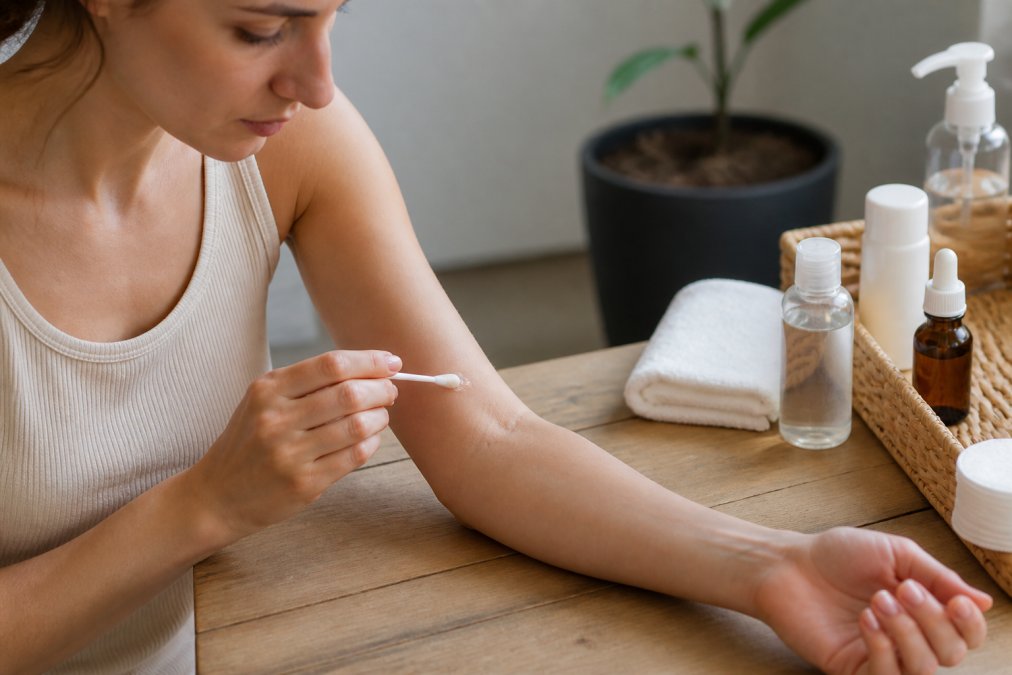
The 48-Hour, Two-Phase Patch Test Protocol
Phase 1: The Initial Application (Day 1)
- Choose a test area on your inner forearm, about two inches below the elbow crease. This area has thinner skin than your upper arm but is less sensitive than your face.
- Clean the area with a mild, fragrance-free cleanser and pat dry. Wait 15 minutes to ensure your skin's moisture barrier is balanced.
- Apply a pea-sized amount of the product to a 1-inch diameter area. Do not rub it in vigorously; apply a thin, even layer.
- Leave the area uncovered. Do not apply a bandage, as occlusion can increase penetration and cause a false positive reaction.
- Set a timer for 15 minutes. Observe the area. If you experience intense burning, immediate swelling, or hives, wash the product off with cool water and do not proceed. This indicates a likely allergy.
- If no immediate reaction occurs, leave the product on and check the area periodically over the next 24 hours.
Phase 2: The Delayed Reaction Check (Day 2)
- After 24 hours, examine the test site. Look for any redness, raised bumps, itching, or a rash that was not present at the 15-minute mark.
- If the area is completely clear, apply a second, slightly larger amount (about the size of a nickel) to the same spot.
- Wait another 24 hours. This second application is critical because it tests for cumulative irritation and delayed hypersensitivity reactions, which can take up to 48 hours to manifest.
Interpreting Your Results
- Negative Result: If the area remains clear after the full 48 hours, you have a low likelihood of an immediate allergic reaction. This does not guarantee your face will tolerate the product, but it is a strong green light to proceed with caution.
- Mild Redness or Itching: This suggests irritation rather than a true allergy. Wait 72 hours for the skin to fully recover. If you still want to try the product, dilute it by mixing a drop with your regular moisturizer before applying to your face.
- Hives, Swelling, or Spreading Rash: This is a positive allergic response. Do not use the product on your face. Wash the area with mild soap and water, and consider taking an oral antihistamine like cetirizine (Zyrtec) or loratadine (Claritin) if the itching is severe. If you experience difficulty breathing, throat tightness, or dizziness, seek emergency medical attention immediately.
Why Your Face Needs a Second, Smaller Test
Facial skin is significantly more permeable than forearm skin, especially around the eyes, cheeks, and nasolabial folds (peer-reviewed research). A negative arm test does not mean your face is safe. When you first apply the product to your face, follow these rules:
- Apply only to a small area, such as one side of your jawline or in front of your ear.
- Use a thin layer and leave it on for no more than 2 hours.
- Wash it off and observe the area for 24 hours.
- If no reaction occurs, you can begin using it on your full face, but start with once every other day for the first week.
This two-phase protocol is more conservative than most brands recommend, but it accounts for the difference between a true IgE-mediated allergy and simple contact dermatitis. When in doubt, err on the side of caution. The temporary plumping effect is not worth a trip to the emergency room.
Is Bee Venom Safe for Daily Use?
For most users who pass a patch test, bee venom is safe for daily use if formulated at a sensible concentration and your skin shows no irritation. However, daily use is not necessary. Many practitioners find that using a bee venom serum two to three times per week maintains the plumping effect while giving your skin barrier time to recover.
The question of "is bee venom safe for daily use" often comes down to the supporting ingredients. A well-formulated product pairs bee venom with soothing and hydrating agents like hyaluronic acid to offset dryness. If you experience persistent redness or peeling, you are likely using it too frequently or the concentration is too high. Reduce frequency to once a week or discontinue use.
Bee Venom vs Copper Peptides: Which Is Right for You?
Choosing between bee venom and copper peptides depends on your primary skin goal and tolerance for irritation. Bee venom offers an immediate, temporary plumping effect but carries a higher risk of allergic reaction and dermal irritation. Copper peptides, specifically GHK-Cu, are signaling peptides that promote collagen production and cellular regeneration without the inflammatory trigger.
| Ingredient | Primary Action | Best For | Key Consideration |
|---|---|---|---|
| Bee Venom | Temporary plumping via histamine response | Events, immediate firming | Allergy risk, patch test required |
| Copper Peptides | Long-term collagen support | Anti-aging, skin repair | Slower visible results |
The good news is you do not have to choose. A serum that fuses both ingredients, like the VAMPIRE TX FACE SERUM, delivers the immediate cosmetic lift from bee venom while copper peptides work on the underlying structure over time. This addresses each ingredient's main weakness: bee venom's effects are fleeting, and copper peptides require patience. For busy professionals wanting a simplified, high-efficiency routine, this all-in-one approach removes the guesswork.
Who Should Avoid Bee Venom Products?
Bee venom is not for everyone. Beyond the obvious allergy warning, specific medical conditions, medication interactions, and ingredient conflicts can turn a supposedly natural product into a source of serious irritation. Here is who should steer clear, and why.
Absolute Contraindications
- People with bee or wasp allergies: This is non-negotiable. A diagnosis of anaphylaxis to hymenoptera venom (the family that includes bees, wasps, and hornets) means topical application can trigger the same systemic response. The venom peptides are small enough to penetrate the epidermis and reach mast cells in the dermis, potentially causing a severe reaction.
- Individuals with mast cell disorders: Conditions like mastocytosis or MCAS (Mast Cell Activation Syndrome) cause an abnormal accumulation or hyper-reactivity of mast cells. Bee venom directly triggers these cells to release histamine, which can cause widespread flushing, hypotension, and anaphylaxis even in the absence of a specific bee venom allergy.
High-Risk Categories Requiring Medical Clearance
- Pregnant or nursing individuals: The lack of clinical safety data is the primary concern. Melittin, the main peptide in bee venom, has been shown in laboratory studies to affect smooth muscle contraction. While topical absorption is minimal, the precautionary principle applies, and most dermatologists advise against use during pregnancy.
- Those with autoimmune conditions: Bee venom is an immune system stimulant. For individuals with psoriasis, lupus, or rheumatoid arthritis, the inflammatory cascade triggered by the venom can potentially exacerbate the underlying condition. This is particularly relevant for those with cutaneous lupus, where even mild skin irritation can trigger a flare.
- Individuals with compromised skin barriers: Active eczema (atopic dermatitis), rosacea flare-ups, or any open wound means your skin's protective lipid barrier is breached. Bee venom will penetrate deeper and at a higher concentration, significantly increasing the risk of severe irritation, contact dermatitis, and systemic absorption.
Medication Interactions You May Not Have Considered
- Blood thinners (anticoagulants and antiplatelets): Bee venom increases local blood flow and can cause micro-capillary dilation. If you are on warfarin (Coumadin), apixaban (Eliquis), or clopidogrel (Plavix), the risk of bruising and prolonged redness at the application site is elevated.
- ACE inhibitors: This class of blood pressure medication, including lisinopril and enalapril, can increase the severity of allergic reactions by inhibiting the breakdown of bradykinin, a peptide involved in the inflammatory response. Even a mild reaction to bee venom can become more pronounced.
- Beta-blockers: These medications can interfere with the body's ability to respond to epinephrine, which is the first-line treatment for anaphylaxis. If you are on a beta-blocker and experience a severe reaction, it may be harder to treat.
Ingredient Interactions: What Not to Layer With Bee Venom
One of the most overlooked safety issues is not the bee venom itself, but what you pair it with. Bee venom is a potent bioactive that relies on a mild inflammatory response. Layering it with other active ingredients can amplify irritation or neutralize the formula.
| Ingredient | Interaction Risk | Recommendation |
|---|---|---|
| Retinol / Retinoids | Both increase cell turnover and compromise the skin barrier. Combined use can cause peeling, redness, and chemical burns. | Do not use on the same day. Wait 24-48 hours after retinol before applying bee venom. |
| Vitamin C (L-ascorbic acid) | Lowers skin pH, which can increase the penetration of bee venom peptides, leading to a stronger-than-intended histamine response. | Use Vitamin C in the morning and bee venom at night, or alternate days. |
| AHAs/BHAs (glycolic, salicylic acid) | Exfoliating acids strip the outer stratum corneum, removing the protective barrier that would normally limit venom absorption. | Avoid using exfoliating acids for 48 hours before your first bee venom application. |
| Benzoyl Peroxide | Highly drying and irritating on its own; combined with bee venom, it can cause significant contact dermatitis. | Do not layer. Use benzoyl peroxide on affected areas only, and keep bee venom away from those spots. |
The common thread is that bee venom is not a passive botanical extract; it is an active immune modulator. Respecting its potency means understanding what it interacts with in your body and your medicine cabinet.
Final Verdict on Bee Venom Safety
So, is bee venom safe for face? The answer is a qualified yes. For the majority of people without a bee venom allergy, properly formulated products are safe when introduced gradually and used with respect for the ingredient's potency. The key is to source products from brands that prioritize safe concentration levels and transparent formulation, and to never skip the patch test.
The biggest mistake is treating bee venom like a gentle botanical extract. It is a potent bioactive compound that demands caution. Used correctly, it offers a legitimate, temporary skin-plumping effect. Used carelessly, it can cause uncomfortable irritation or a serious allergic reaction.
For those ready to try it, the VAMPIRE TX FACE SERUM offers a balanced entry point at $19.00. It combines bee venom with copper peptides and hyaluronic acid to deliver immediate effects while supporting long-term skin health. The formula is a simplified, all-in-one age-defying solution without the luxury brand markup.
Frequently Asked Questions
Can I use bee venom cream on my face every day?
Daily use is generally safe for most people once a patch test confirms you have no allergy, but it depends on the formulation and your skin sensitivity. Start by applying every other day for the first two weeks to let your skin adjust. If no irritation appears, you can move to daily application. Products with higher concentration levels of bee venom may cause dermal irritation with daily use, so always follow the manufacturer's instructions.
What does bee venom do on skin?
Bee venom contains melittin and other bioactive compounds that stimulate blood flow and trigger a mild inflammatory response in the skin. This response tricks the skin into thinking it needs repair, which can boost collagen production and improve skin elasticity. The result is a temporary skin plumping effect that reduces the appearance of fine lines and wrinkles. This mechanism is why marketers often call it a natural botox alternative, though the effect is milder and temporary.
Who should avoid using bee venom skincare products?
Anyone with a known allergy to bee stings must avoid bee venom products entirely due to the risk of anaphylaxis. People with hypersensitive skin, active eczema, or rosacea should also steer clear. Pregnant or nursing women should consult a doctor before use. If you have never been stung by a bee, do a patch test first to rule out an allergic reaction before applying the product to your face.
How is bee venom different from copper peptides for anti-aging?
Bee venom works by stimulating a mild inflammatory response that encourages collagen production for a temporary plumping effect. Copper peptides, specifically GHK-Cu, work differently: they signal skin cells to produce collagen and elastin directly, supporting cellular regeneration and skin barrier repair over time. Copper peptides are generally better tolerated by sensitive skin since they do not trigger a histamine response. Many high-performance serums combine both ingredients for complementary anti-aging benefits.
Bee venom can be a valuable addition to an anti-aging routine, but it demands informed use. Understanding your allergy status and committing to a patch test are the non-negotiable first steps. At Vampire Tx, we built our face serum to deliver high-performance cellular repair by pairing bee venom's instant firming with copper peptides' regenerative power. Get started with Vampire Tx and lock your skin in its prime with a serum that works as hard as you do.