
Table of Contents
- Why Skincare Layering Order Changes Everything
- The Golden Rule: How to Layer Serums Correctly by Consistency
- Skincare Ingredient Clashes You Need to Know
- How Long to Wait Between Serums
- Skin Barrier Health: When Layering Too Much Backfires
- How to Layer Serums Correctly for Your Skin Type
- Common Layering Mistakes and How to Fix Them
- Frequently Asked Questions
Last Updated: September 1, 2026
Why Skincare Layering Order Changes Everything
Skincare layering order is the sequence in which you apply products to your face, and getting it wrong can completely undermine the effectiveness of every serum in your routine. The answer is almost always application order.
Here's the core problem: your skin is a selective barrier. It doesn't absorb everything you put on it equally. Molecular weight, pH, and formulation type all determine whether an active ingredient actually reaches the skin layers where it does its work. Apply a heavier, occlusive product first and you've physically blocked the lighter serums that follow. The actives sit on the surface and eventually rub off.
This isn't a minor inconvenience. It's the difference between a routine that delivers visible results and one that just feels like a routine.
The sequence also matters for ingredient chemistry. Certain active ingredients require a specific pH window to function. Apply them in the wrong order and you've either deactivated them or created an environment where they react poorly with adjacent formulas. More on that in the ingredient clashes section below, because it's the part most guides gloss over.
The good news: once you understand the logic behind layering, the rules become intuitive. You won't need to memorize a sequence. You'll understand why the sequence works.
The Golden Rule: How to Layer Serums Correctly by Consistency
The foundational rule for how to layer serums correctly is simple: apply thinnest to thickest. Start with the most watery, lightweight formulas and build toward heavier, oil-based or occlusive products. This isn't arbitrary. It follows the physics of absorption.
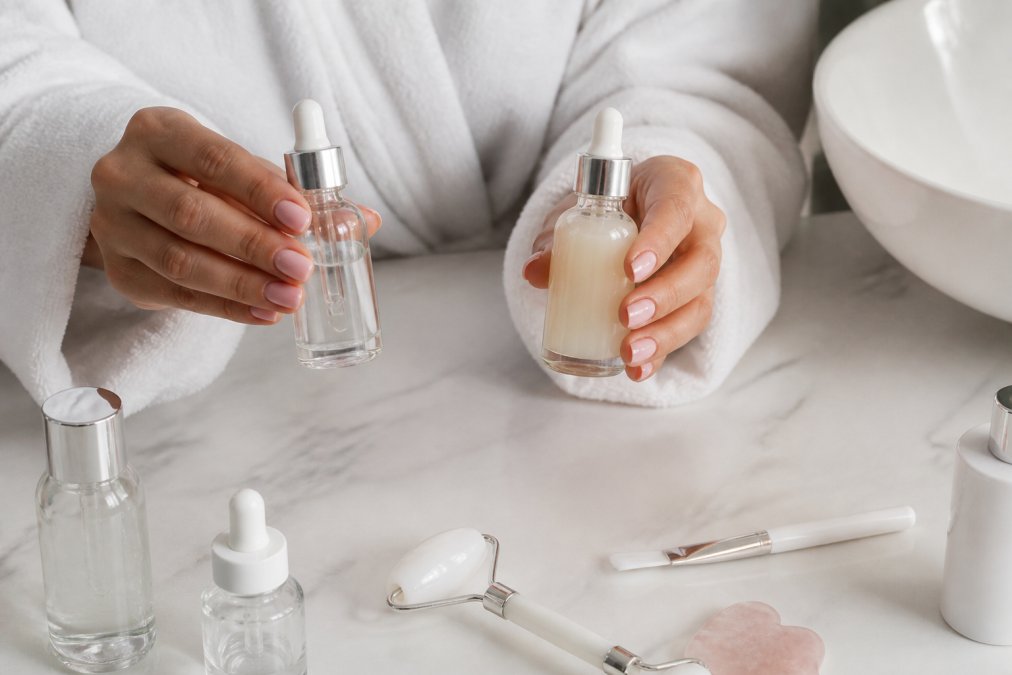
Thin, water-based formulas have smaller molecules and lower viscosity. They penetrate quickly into the upper layers of the skin. If you apply a thick, lipid-based formula first, you create a physical barrier that traps the lighter serum on top, where it can't absorb properly. The result is pilling, product waste, and zero dermatological efficacy.
Step 1: Cleanse and Prep Damp Skin
Start with a clean face, but don't dry it completely. Applying serums to slightly damp skin significantly improves absorption, particularly for humectant ingredients like hyaluronic acid, which draws moisture from the surrounding environment into the skin. Bone-dry skin absorbs less. This is one of those small details that makes a measurable difference over time.
Step 2: Apply Water-Based Serums First
Water-based serums go on first. These are your lightest, most fluid formulas, typically vitamin C serums, niacinamide formulations, and most hyaluronic acid products. They have high water content, low viscosity, and fast absorption rates. Apply a few drops, press gently into the skin, and wait for them to absorb before moving to the next layer.
Step 3: Follow with Thicker, Oil-Based Formulas
After your water-based layers have absorbed, apply thicker serums and treatments. Peptide serums, retinol formulations, and any anhydrous or lipid-based products belong here. These have higher molecular weights and need to sit on top of the water-based layers, not beneath them. A serum like the Vampire Tx Face Serum, which combines copper peptides and hyaluronic acid in an advanced formula, fits naturally into this step.

Step 4: Seal with Moisturizer or Occlusive
Finish with a moisturizer to lock in everything underneath. If you use a dedicated occlusive, like a facial oil or balm, that goes on last. Occlusives create a physical seal that slows transepidermal water loss and keeps your actives working longer. Skipping this step means the serums you just applied are evaporating along with your skin's natural moisture.
Skincare Ingredient Clashes You Need to Know
Not all serums play nicely together. Skincare ingredient clashes are one of the most underserved topics in mainstream guides, and they're responsible for a significant share of the irritation, breakouts, and stalled results that people blame on their products being "wrong for their skin."
The issue isn't always the ingredients themselves. It's the chemistry of combining them.
pH-Dependent Conflicts: Vitamin C, Exfoliants, and Retinol
This is where layering becomes genuinely technical. Vitamin C, specifically L-ascorbic acid, requires a low pH environment (typically below 3.5) to remain stable and biologically active. Retinol, on the other hand, functions best at a higher pH. Apply them together in the same routine and you compromise the bioavailability of both. According to dermatology research published by the American Academy of Dermatology, combining highly acidic actives with pH-sensitive ingredients in rapid succession can reduce their individual effectiveness and increase the likelihood of irritation.
The practical fix: separate vitamin C and retinol into different routines. Vitamin C in the morning, retinol at night. This isn't about fear, it's about giving each ingredient the pH environment it needs to work.
Exfoliants, whether AHAs like glycolic acid or BHAs like salicylic acid, present a similar issue. They work at low pH and can destabilize other actives if layered directly on top or beneath them. Use exfoliants as a standalone step, and wait at least several minutes before applying anything else.
Ingredients That Work Better Together
Some combinations actively enhance each other. Hyaluronic acid pairs well with almost everything because it's a humectant, not an active in the traditional sense. It supports skin hydration and creates a more receptive surface for other ingredients.
Niacinamide and peptides are another strong pairing. Both operate at a relatively neutral pH, and niacinamide supports the skin barrier in ways that make peptide absorption more effective. The National Institutes of Health research on niacinamide and skin barrier function documents how niacinamide supports ceramide synthesis, which reinforces the skin barrier and improves overall skin health over time.
Copper peptides, like GHK-Cu found in the Vampire Tx formula, work synergistically with hyaluronic acid. The peptide supports cellular repair while the hyaluronic acid maintains the hydration environment that makes that repair more effective.
How Long to Wait Between Serums
The standard guidance is to wait 30 to 60 seconds between serum layers, but the honest answer is that it depends on the formula's consistency and how quickly it absorbs on your skin.

Water-based serums with low viscosity absorb in under a minute for most skin types. You'll feel the tackiness disappear and the skin surface will look matte or slightly dewy rather than wet. That's your cue to apply the next layer.
Thicker serums take longer. A peptide serum or a richer oil-based formula may need two to three minutes before the next product goes on. Rushing this step is one of the most common layering mistakes and the primary cause of pilling, where products ball up on the skin surface instead of absorbing.
| Serum Type | Wait Time | Key Sign It's Ready |
|---|---|---|
| Water-based (vitamin C, HA) | 30-60 seconds | Tackiness gone, skin feels smooth |
| Niacinamide / peptide serums | 60-90 seconds | Slight sheen absorbed, no slipperiness |
| Thicker oil-based serums | 2-3 minutes | Surface feels dry, not greasy |
| Retinol formulas | 2-3 minutes | Fully absorbed before moisturizer |
For pH-sensitive actives like vitamin C or exfoliants, a longer wait of two to three minutes is worth the extra time. It allows the skin's surface pH to normalize before you apply the next product, reducing the risk of ingredient interactions.
Skin Barrier Health: When Layering Too Much Backfires
More serums do not equal better results. This is the part most multi-step routines get wrong.
The skin barrier is a lipid-protein matrix that protects against environmental damage, regulates moisture, and controls what enters and exits the skin. Over-layering, especially with multiple active ingredients in a single routine, can disrupt this barrier. The result looks like sensitivity: redness, tightness, flaking, and a sudden increase in reactivity to products that previously worked fine.
As documented in peer-reviewed research on skin barrier dysfunction in the Journal of Investigative Dermatology, repeated disruption of the skin barrier through excessive use of exfoliants and actives compromises its structural integrity over time.
A common mistake is treating every serum as additive. Two exfoliants don't give you twice the results; they give you twice the barrier disruption. Two vitamin C serums don't double the antioxidant protection; they increase the risk of irritation without proportional benefit.
The practical rule: limit yourself to two to three active serums per routine, maximum. If your skin is showing signs of barrier compromise, strip the routine back to a gentle cleanser, a single hydrating serum, and a moisturizer for a week. Let the barrier recover before reintroducing actives.
How to Layer Serums Correctly for Your Skin Type
Skincare layering order isn't one-size-fits-all. The same sequence that works for dry skin can cause congestion on oily skin. Knowing how to layer serums correctly for your specific skin type is what separates a routine that works from one that causes new problems.
Oily and Acne-Prone Skin
Oily skin benefits from lightweight, water-based serums and should avoid heavy occlusives that trap sebum. Prioritize niacinamide, which regulates oil production and reduces the appearance of pores. Hyaluronic acid is still valuable here because oily skin can be simultaneously dehydrated.
Skip facial oils entirely unless they're specifically non-comedogenic. Finish with a lightweight gel moisturizer rather than a cream. The goal is hydration without occlusion.
Dry and Mature Skin
Dry skin needs more layers and richer formulas. Apply a hydrating water-based serum first, then follow with a peptide or repair serum, then a heavier moisturizer, and finish with a facial oil or occlusive if needed. Mature skin benefits significantly from copper peptides, which support collagen synthesis and cellular repair. The Vampire Tx Face Serum, with its GHK-Cu and hyaluronic acid combination, is formulated for exactly this skin concern.
Don't skip the occlusive step. Dry skin loses moisture rapidly, and sealing in your layers is what makes the routine effective overnight.
Sensitive Skin
Sensitive skin demands restraint. One active at a time, maximum. Introduce new serums one at a time, with at least a week between additions, so you can identify any reactive ingredient. Avoid combining exfoliants with retinol or vitamin C. Stick to fragrance-free formulas.
Bee venom, an ingredient in the Vampire Tx formula, sounds intense but works differently from traditional irritants. It stimulates circulation and collagen production through a mechanism that doesn't require the aggressive exfoliation that sensitizes skin. That said, if your skin is currently compromised or actively inflamed, let the barrier recover first before introducing any new active.
Common Layering Mistakes and How to Fix Them
Most layering errors follow predictable patterns. Here's what actually goes wrong and how to correct it:
Applying serums to completely dry skin. Fix: leave skin slightly damp after cleansing, especially before applying hyaluronic acid.
Layering oil-based products before water-based ones. Fix: always check consistency before you apply. If it feels silky or slick, it's probably oil-based and goes on later.
Skipping wait time between layers. Fix: use the absorption test. If the product still feels wet or tacky, wait. Pilling is almost always caused by applying the next product too soon.
Using too many actives at once. Fix: audit your routine. Identify which actives you're actually using and whether any are redundant or conflicting. Two exfoliants in one routine is always a mistake.
Mixing vitamin C with retinol in the same session. Fix: vitamin C in the morning, retinol at night. No exceptions.
Applying moisturizer before serums have absorbed. Fix: serums go on before moisturizer, always. Moisturizer is the penultimate step, not a base layer.
| Mistake | Why It Happens | The Fix |
|---|---|---|
| Applying to dry skin | Habit, time pressure | Leave skin slightly damp post-cleanse |
| Oil before water | Unfamiliar with formula types | Check consistency; water-based always first |
| No wait time between layers | Rushing the routine | Wait for absorption before next step |
| Too many actives | Thinking more equals better | Limit to 2-3 actives per routine |
| Vitamin C + retinol together | Following incomplete advice | Separate AM and PM routines |
Building a serum routine that actually works requires more than good products. Sequencing, timing, and ingredient compatibility all determine whether your actives reach the skin layers where they make a difference. If you're ready to simplify without sacrificing performance, the Vampire Tx Face Serum brings copper peptides, hyaluronic acid, and bee venom into a single, high-performance formula designed to work as a core layer in any routine. No redundant steps, no luxury markup. Shop now and give your skin the ingredients it needs, in the right order.
Frequently Asked Questions
Q: What goes first, retinol, niacinamide, or hyaluronic acid?
A: Apply hyaluronic acid first on damp skin, since it draws moisture into the skin and has the thinnest consistency. Niacinamide goes next as a mid-weight water-based serum. Retinol follows after, as it tends to be formulated in a slightly heavier base. This order supports absorption and reduces the chance of irritation. Avoid applying vitamin C and retinol in the same routine, vitamin C works best in the morning, retinol at night.
Q: How long should I wait between applying serums?
A: Wait 30 to 60 seconds between each serum layer. That window allows each formula to absorb before the next one is applied, which reduces pilling and prevents dilution of active ingredients. For pH-sensitive actives like vitamin C or AHA exfoliants, a full 60-second wait is worth it. You do not need to wait until your skin feels completely dry, a slightly tacky surface actually helps humectants like hyaluronic acid bind better.
Q: Is layering 3 serums too much?
A: Three serums can work, but only if they address different skin concerns and do not contain conflicting active ingredients. The bigger risk is over-layering, which can compromise the skin barrier over time and cause irritation, redness, or breakouts. A smarter approach for most people is one targeted serum in the morning and one at night, or a well-formulated multi-active serum that handles several concerns in a single step, which cuts down on both cost and complexity.
Q: Does the order of skincare products really matter?
A: Yes. Skin absorbs ingredients in the order they are applied, and the wrong sequence can block penetration or trigger ingredient conflicts. Water-based serums applied after oil-based ones cannot penetrate the lipid layer sitting on top. Certain active ingredients, like vitamin C and niacinamide used together in high concentrations, can also reduce each other's effectiveness. Getting the skincare layering order right is one of the simplest ways to get more out of the products you are already using.
This article was written using GrandRanker