
Table of Contents
- What Is Bee Venom Serum and Why Beginners Should Care
- Is Bee Venom Safe for Daily Use?
- How to Patch Test Skincare Products Before Full Application
- Bee Venom vs Copper Peptides: Which Works Better for Anti-Aging
- Key Ingredients to Look For in a Beginner-Friendly Bee Venom Serum
- What to Expect: Timeline and Results for New Users
- Sustainability and Ethical Sourcing in Bee Venom Products
- Frequently Asked Questions
Last Updated: September 22, 2026
What Is Bee Venom Serum and Why Beginners Should Care
Bee venom serum is a topical skincare product containing bee venom extract, designed to improve skin firmness, smoothness, and hydration through anti-inflammatory and peptide-rich properties. Understanding what bee venom actually does is the first step toward making an informed choice.
Bee venom contains melittin, a peptide that stimulates collagen production and skin elasticity. Combined with hyaluronic acid and copper peptides, it tackles fine lines, wrinkles, and loss of firmness without requiring a complex multi-step routine.
For beginners, you get clinical efficacy without the luxury brand markup. Vampire Tx fuses copper peptides and bee venom into a single serum at an accessible price point, eliminating the need to juggle multiple products.

Is Bee Venom Safe for Daily Use?
Yes, bee venom is safe for daily use for most skin types when properly formulated and introduced gradually. Safety depends on your skin sensitivity, the product's concentration, and how you introduce it. Beginners commonly jump straight to daily use without a transition period. Your skin barrier needs time to adapt to active ingredients, especially peptides that stimulate cellular activity.
If you have sensitive skin, the ingredient is actually anti-inflammatory and can help calm reactive skin. Start conservatively: use every other day for two weeks, then gradually increase to daily use if tolerated.
The main risk is allergy. If you have a documented bee pollen allergy or severe sensitivity to hymenoptera venom, consult a dermatologist before use.
How to Patch Test Skincare Products Before Full Application
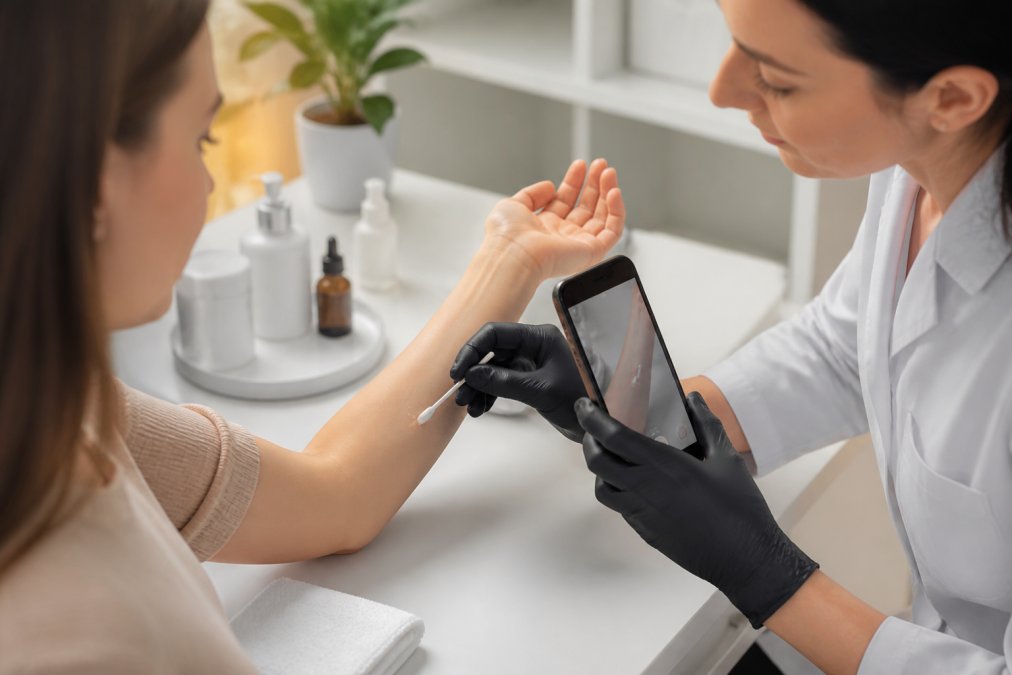
A proper patch test takes 48 hours and prevents costly mistakes.
Step 1: Choose your test location. The inner forearm or behind your ear are ideal because these areas have thin, sensitive skin that mirrors facial reactions. Avoid testing on your face directly.
Step 2: Cleanse thoroughly. Wash the test area with a gentle, fragrance-free cleanser and pat dry completely. Wait at least 10 minutes before applying the product.
Step 3: Apply a pea-sized amount. A tiny dab is enough to detect a reaction. Use a clean fingertip or disposable applicator, press gently, and let it absorb naturally.
Step 4: Document your baseline. Take a photo of the test area before application under consistent lighting to eliminate guesswork.
Step 5: Wait 48 hours without interference. Don't shower directly over the test spot or apply other products to it. If you must shower, cover the area with a waterproof bandage. Note any sensations (tingling, warmth, itching) at the 24-hour and 48-hour marks.
Step 6: Evaluate against your baseline. Take a second photo under the same lighting conditions. Compare it to your baseline photo. Here's what different reactions mean:
- No visible change, no sensation: You're safe to proceed to full facial application.
- Mild redness that fades within 1 hour of cleansing: This is often a normal response to occlusion (the serum sitting on skin under a layer of moisture). Proceed cautiously, starting with every-other-day application.
- Persistent redness lasting more than 2 hours, itching, or slight warmth: Your skin is reacting. Wait 24 more hours. If the reaction persists or worsens, discontinue. If it resolves completely, you may have a mild sensitivity that requires slower introduction (once weekly for 2 weeks before increasing frequency).
- Hives, swelling, intense itching, or burning sensation: Stop immediately. Wash the area gently with cool water and a mild cleanser. Do not apply the product to your face. Consult a dermatologist before using this serum.
Understanding the difference between irritation and allergy:
Irritation is localized redness, mild itching, or dryness that resolves within hours. Allergy involves hives, swelling, or a burning sensation that persists or worsens. Allergic reactions require immediate discontinuation and professional evaluation. If you have a documented bee pollen allergy or anaphylaxis history to bee stings, consult a dermatologist before using any bee venom product.
Common beginner mistakes to avoid:
- Testing on your face instead of your arm
- Using too much product
- Stopping the test early (48 hours is the standard)
- Ignoring mild irritation and proceeding anyway
- Testing multiple products simultaneously
- Applying the serum to damp skin
Bee Venom vs Copper Peptides: Which Works Better for Anti-Aging
This comparison matters because both ingredients address aging, but they work through different mechanisms. Understanding the difference helps you choose the right product for your goals.
Bee venom's strength: It stimulates collagen production and provides immediate skin-plumping effects through hydration. Results appear within 2-4 weeks.
Copper peptides' strength: They support collagen and elastin synthesis at a deeper level with antimicrobial and antioxidant properties. Results appear after 4-8 weeks.
Combining them is the real advantage. Vampire Tx's formula provides immediate plumping and hydration from bee venom, while copper peptides work underneath for long-term collagen support. You get visible results quickly plus structural improvement over time.
| Ingredient | Primary Benefit | Timeline | Best For |
|---|---|---|---|
| Bee Venom | Skin-plumping, collagen stimulation | 2-4 weeks | Immediate visible results |
| Copper Peptides | Deep cellular repair, elastin support | 4-8 weeks | Long-term anti-aging |
| Combined Formula | Both immediate and sustained benefits | 2-4 weeks (visible), 8+ weeks (structural) | Comprehensive anti-aging |
For beginners specifically, the combination approach removes decision paralysis. You're not choosing between ingredients, you're getting both in one product, which simplifies your routine and maximizes efficacy.
Key Ingredients to Look For in a Beginner-Friendly Bee Venom Serum
Beyond bee venom itself, the supporting cast of ingredients determines whether a serum actually works or just feels luxurious. Here's what separates effective formulas from marketing hype, plus what NOT to combine with bee venom.
Ingredients that amplify bee venom's effectiveness:
Hyaluronic acid is non-negotiable. This humectant pulls moisture into the skin, amplifying bee venom's plumping effect. Look for it high in the ingredient list. Sodium hyaluronate (the salt form) is more stable and works equally well.
Manuka honey is antimicrobial, anti-inflammatory, and stabilizes bee venom in the formula. It enhances the skin-plumping effect and improves shelf stability.
Peptides beyond melittin matter. Copper peptides support collagen synthesis at a deeper level than bee venom alone. A formula with multiple peptide types addresses aging from different angles.
Glycerin is essential. It works synergistically with hyaluronic acid to lock moisture into the skin.
Niacinamide (vitamin B3) is a bonus ingredient that strengthens the skin barrier, reduces redness, and enhances the anti-inflammatory benefits of bee venom. It's especially valuable if you have sensitive skin, as it helps your skin tolerate the peptide stimulation without excessive irritation.
Ingredients to AVOID or use cautiously with bee venom:
This is where most beginner guides fail.
Red flags in the ingredient list:
- Bee venom listed below the 5th ingredient (concentration too low to be effective)
- Fragrance or essential oils high in the list (unnecessary irritants for sensitive skin)
- Silicones as the second ingredient (they feel nice but don't deliver results)
- Lack of preservatives (the product will degrade quickly and become unsafe)
- Alcohol denat in the top 5 (drying and irritating)
- No humectants (hyaluronic acid, glycerin, or manuka honey) listed at all
The ideal beginner formula includes:
- Bee venom (ideally 2-5% concentration, though most brands don't disclose this)
- Hyaluronic acid or sodium hyaluronate
- Glycerin
- Manuka honey or another humectant
- Copper peptides or other collagen-supporting peptides
- Niacinamide (optional but beneficial)
- Minimal to no fragrance
- Appropriate preservatives (phenoxyethanol, methylisothiazolinone, or natural alternatives)
What to Expect: Timeline and Results for New Users
This is where most beginner guides get vague. You need a realistic timeline, not marketing promises. Here's what actually happens when you start using a bee venom serum.
Sustainability and Ethical Sourcing in Bee Venom Products
Bee venom extraction can harm bee colonies if done irresponsibly. Ethical sourcing uses electrical stimulation to collect venom without harming the colony. The bees recover fully, and the hive remains healthy.
Frequently Asked Questions
Is bee venom serum safe for daily use?
Bee venom serum can be used daily for most skin types when properly formulated and introduced gradually. Start with 2-3 times per week, then increase frequency as your skin builds tolerance. The active compound melittin triggers anti-inflammatory and collagen-boosting responses, but sensitive skin may experience mild redness initially. Always patch test first and discontinue if you develop persistent irritation or suspect an allergic reaction.
How long does it take to see results from bee venom serum?
Most users notice improved skin hydration and a smoother texture within 2-4 weeks of consistent use. Fine lines and skin firmness improvements typically appear after 6-8 weeks. Results depend on your starting skin condition, age, and how consistently you use the serum as part of your skincare routine.
What's the difference between bee venom and copper peptides?
Bee venom works to help improve the appearance of firmness, smoothness, and hydration. Copper peptides (like GHK-Cu) directly stimulate collagen synthesis and improve skin elasticity at the cellular level. Many advanced formulas combine both ingredients for complementary benefits.
Can I use bee venom serum if I have sensitive skin?
Yes, but introduce it carefully. The initial application can cause mild redness or tingling. Start with a patch test on your inner arm for 24-48 hours. If no reaction occurs, apply a tiny amount to your face 2-3 times weekly, gradually increasing frequency. If persistent irritation develops, discontinue and consult a dermatologist.