
Table of Contents
- What to Look for in a Firming Anti Aging Serum
- How to Tighten Sagging Skin on Face Without Injectables
- Copper Peptides for Skin Tightening: What the Research Shows
- How to Layer Anti-Aging Serums for Better Absorption
- Bee Venom and Copper Peptides: Ingredient Synergy and Contraindications
- Long-Term Maintenance vs. Immediate Plumping: Setting Realistic Expectations
- Choosing the Best Anti Aging Serum for Your Skin Type
- Frequently Asked Questions
Last Updated: September 14, 2026
What to Look for in a Firming Anti Aging Serum
Firming is not a marketing word. It describes a measurable change in how skin behaves: how it bounces back when you press it, how it holds its shape along the jawline, how dense it feels between your fingers. That change comes from the dermal matrix, the structural layer where collagen and elastin fibers sit. An anti aging serum that targets firmness has to reach that layer with ingredients that support it, not just sit on the surface and plump.
Here is what actually separates a firming formula from a hydrating one.
Ingredient concentration and delivery. Copper peptides, retinoids, and growth factors all need to arrive intact. Look for formulas that pair peptides with hyaluronic acid so the barrier stays supported while active ingredients work. The American Academy of Dermatology's guidance on anti-aging skincare notes that consistent topical use, not one-time application, drives visible results.
Barrier support. Transepidermal water loss undermines firmness. If your skin is losing moisture faster than it retains it, fine lines and wrinkles look deeper and skin feels less supple. Non-comedogenic formulas that reinforce the skin barrier function let active ingredients do their job without irritation.
Evidence, not adjectives. Dermatologist-tested and clinical efficacy claims should be specific. Vague language like "visibly lifts" tells you nothing. Look for named ingredients with published research behind them.
A firming serum is a topical product designed to improve the appearance of skin elasticity and firmness by delivering active ingredients that support collagen production and the dermal matrix. It works gradually, over weeks, not minutes.
How to Tighten Sagging Skin on Face Without Injectables
Topical serums can improve the appearance of sagging skin by supporting collagen and elastin production, but they work on a different timeline than injectables. The question is not whether a serum replaces a procedure. It is whether the right serum, used consistently, meaningfully changes how firm your skin looks and feels.
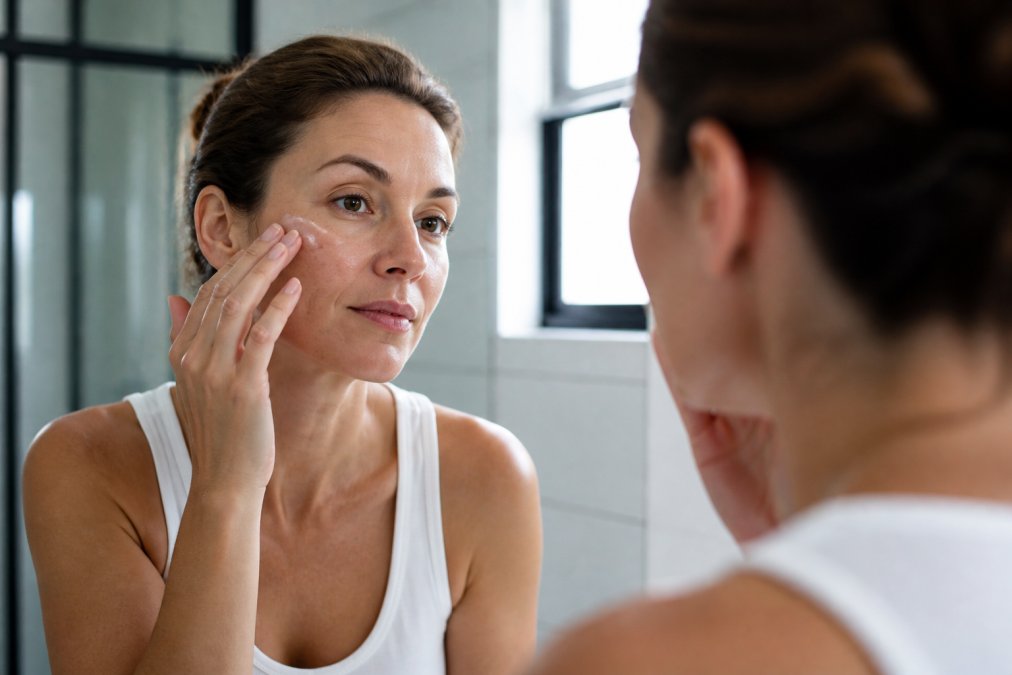
Three levers matter most.
- Cellular turnover. Retinoids and peptides encourage the skin to renew itself faster, which thickens the epidermal layer over time.
- Collagen support. Copper peptides and growth factors signal the skin to produce more of its own structural proteins.
- Hydration levels. Hyaluronic acid draws water into the upper layers, creating a plumping effect that reduces the visible depth of fine lines.
What most guides miss is that these levers compound. A serum that only hydrates looks good for a day. A serum that supports collagen and hydration together changes the baseline. In practice, this means you should judge a firming product over eight to twelve weeks, not eight to twelve days.
Copper Peptides for Skin Tightening: What the Research Shows
Copper peptides for skin tightening work by delivering copper ions to the skin in a form it can use. The most studied peptide in this category is GHK-Cu, a copper-binding tripeptide that appears naturally in human plasma and declines with age. Research suggests it supports collagen synthesis, antioxidant activity, and the repair processes that keep skin firm (pubmed.ncbi.nlm.nih.gov).
The practical takeaway: copper peptides are among the better-supported topical ingredients for firmness, but they are sensitive. They degrade in the presence of strong acids and certain forms of vitamin C. If you layer a copper peptide serum with an acidic toner or a high-concentration ascorbic acid product, you may be neutralizing the ingredient you paid for.
This is where ingredient synergy and contraindications matter more than any single hero ingredient. A well-formulated serum accounts for what it will be layered with, not just what is inside the bottle.
How to Layer Anti-Aging Serums for Better Absorption
Order of application determines how much of each ingredient actually absorbs. The rule is thinnest to thickest, water-based before oil-based, and actives before moisturizers. Get the sequence wrong and your most expensive product may never reach the skin.
| Step | Product | Wait Time | Why It Goes Here |
|---|---|---|---|
| 1 | Cleanser | 30 seconds | Removes barrier-blocking residue |
| 2 | Water-based serum (peptides, hyaluronic acid) | 60 seconds | Absorbs fastest, needs bare skin |
| 3 | Treatment serum (retinoid, if used) | 2-3 minutes | Buffered by the first layer |
| 4 | Moisturizer | 60 seconds | Seals in hydration, supports barrier |
| 5 | SPF (morning only) | None | Protects against photoaging |
Viscosity is your guide. If a product feels thicker than the one before it, you have the order right. If it pills or balls up, you applied too much or layered in the wrong sequence.
Bee Venom and Copper Peptides: Ingredient Synergy and Contraindications
Bee venom and copper peptides address firmness through different mechanisms, which is why pairing them interests formulators. Bee venom creates a controlled micro-stimulation that increases blood flow and temporarily tightens the appearance of skin, while copper peptides work on the slower structural level. One gives an immediate plumping effect; the other builds over months. Used together in a single formula, they cover both timelines without forcing you to guess at ratios or layering order.
Most guides list hero ingredients and stop there. The part that actually determines whether a firming serum works is what you put next to it, and what you never should.
Contraindications worth knowing before you layer.
- Copper peptides and strong acids. Glycolic, lactic, and salicylic acid toners at low pH can degrade the peptide bond and strip the copper ion before it reaches the dermis. If you use an acid toner, apply it in the morning and reserve the copper peptide serum for the evening, or wait at least 20 minutes between steps.
- Copper peptides and high-concentration L-ascorbic acid. Vitamin C in its pure ascorbic form is acidic and can neutralize copper peptides on contact. A common workaround is to alternate days rather than stack them, or to use a vitamin C derivative that sits at a higher pH.
- Bee venom and strong irritants. Do not combine bee venom products with high-percentage acids, benzoyl peroxide, or prescription retinoids on the same night. Stacking actives is the most common cause of a compromised barrier, and a damaged barrier makes firmness look worse, not better.
- Retinoids and exfoliating acids. These two together are a classic over-exfoliation trap. If you are using a retinoid for firmness, keep acid exfoliation to once or twice a week and never on the same evening.
Patch testing is not optional for bee venom. If you have a known allergy to bee stings or severely reactive skin, patch test on the inner forearm for 24 hours before applying to the face. Most people with sensitive skin tolerate cosmetic-grade bee venom because the concentration is far lower than a sting, but "most" is not "all." Introduce it slowly, every third night for the first two weeks, then build.
A simple synergy rule. Pair ingredients that work on different layers and different timelines. Copper peptides (structural, slow) plus hyaluronic acid (hydrating, fast) plus a barrier lipid like ceramides is a low-risk stack. Copper peptides plus bee venom is a reasonable pairing when your barrier is intact. Copper peptides plus a strong acid plus a retinoid on the same night is where most people run into trouble.
Vampire Tx builds its face serum around the copper peptide and bee venom pairing in a single formula, so the ratio and the delivery are already settled and you are not layering two separate products with conflicting pH needs.

Long-Term Maintenance vs. Immediate Plumping: Setting Realistic Expectations
Immediate plumping is hydration. Long-term firmness is structural. Confusing the two is why so many people abandon good serums before they work, and why so many cheap serums get credit they have not earned.
What each effect actually is.
Hyaluronic acid and glycerin are humectants (pubmed.ncbi.nlm.nih.gov). They draw water into the upper layers of the epidermis, which temporarily swells the skin surface and softens the look of fine lines. That effect shows up within an hour and fades as the water evaporates, usually within a day. It is real, it is useful, and it is not firmness.
Copper peptides, retinoids, and growth factors work on the dermal matrix. They signal fibroblasts to produce more collagen and elastin, and they support the repair processes that keep that matrix dense. That change is slow because collagen turnover is slow. It also holds, because you have changed the structure rather than the water content.
How to tell which one you are seeing.
- Press your cheek and release. If it bounces back the same way it did an hour ago, you are seeing plumping. If it feels denser than it did a month ago, you are seeing structural change.
- Look at your skin first thing in the morning, before any product. Plumping effects are gone by then. Structural change is still there.
- Compare photos taken in the same light at the same time of day, four weeks apart. This is the only reliable way to judge a firming serum, because daily mirror checks are dominated by hydration and lighting.
A realistic timeline.
- Week 1: Hydration and radiance. Skin looks smoother and feels softer. This is the humectant layer doing its job.
- Weeks 2-4: Texture improvements. Pores look smaller, makeup sits better, and fine lines around the eyes soften slightly.
- Weeks 4-8: Early firmness signals. Skin feels denser, and the jawline and cheek area may look slightly more defined in photos.
- Weeks 8-12: The structural payoff. This is where collagen and elastin changes become visible to the eye, not just to the fingertip.
If a product promises visible lifting in three days, it is selling you water. If it promises structural change in three days, it is not being honest. The best anti aging serum for firmness is the one you will still be using in month three.
Maintenance after the payoff. Once you see the firmness you want, do not stop. Collagen turnover continues for life, and the matrix you built will gradually decline without continued support. Most practitioners suggest keeping the same serum in rotation indefinitely and adjusting only if your barrier changes, for example, after a season of dry indoor air or a course of prescription treatment.
Choosing the Best Anti Aging Serum for Your Skin Type
Skin type decides which firming formula suits you. The ingredients that help one person can overwhelm another, so match the formula to your barrier, not to the loudest review.
- Dry or mature skin: Prioritize copper peptides plus hyaluronic acid. You need structural support and hydration together.
- Oily or combination skin: Look for lightweight, non-comedogenic formulas. Heavy creams can trigger breakouts that set firmness work back.
- Sensitive or reactive skin: Introduce bee venom and retinoids slowly, one at a time, with a patch test first.
- Normal skin in your late 20s or 30s: Focus on prevention. Peptides and antioxidants now reduce photoaging and free radical damage later.
Vampire Tx's face serum is priced at $19.00, which puts a copper peptide and bee venom formula within reach for anyone who has been priced out of luxury skincare. It is a simplified, all-in-one option: one product instead of a three-step routine, which matters if you want results without adding ten minutes to your morning.
Most people quit a firming serum right before it starts working, usually around week three, when hydration has plateaued and structural change has not yet shown up. If you want an anti aging serum that pairs copper peptides with bee venom in one step, without the luxury markup, Vampire Tx is built for exactly that: high-performance cellular repair, a simplified routine, and a formula that supports firmness, smoothness, and hydration together. Shop now and give your skin the full eight weeks it needs.
Frequently Asked Questions
What ingredients should I look for in a firming serum?
Look for copper peptides (GHK-Cu), which support collagen production and skin elasticity, plus hyaluronic acid for hydration and plumping. Bee venom is another ingredient that can help stimulate skin firmness by increasing blood flow. Retinoids and antioxidants like vitamin C also support cellular turnover and protect against free radical damage. A serum combining these ingredients addresses multiple signs of aging at once.
How long does it take to see results from a firming serum?
Most people notice improved hydration and a temporary plumping effect within a few days. Visible improvements in firmness and fine lines typically take 8 to 12 weeks of consistent use. Copper peptides work gradually by supporting collagen production over time, so results build with continued application. Take a photo every two weeks to track changes accurately.
Can I use a firming serum with other anti-aging products?
Yes, but layering order matters. Apply your thinnest, most water-based serum first, then move to thicker formulas. If you use retinoids at night, alternate them with your copper peptide serum rather than applying both at the same time, since they can interfere with each other. Always follow with moisturizer to seal everything in and support your skin barrier function.
What is the difference between a hydrating serum and a firming serum?
A hydrating serum focuses on drawing water into the skin, usually through hyaluronic acid or glycerin, which reduces transepidermal water loss and makes skin look plumper temporarily. A firming serum targets structural support by stimulating collagen and elastin production with ingredients like copper peptides. The best approach combines both: hydration for immediate radiance and firming ingredients for long-term elasticity and suppleness.