
Table of Contents
- The Real Reasons Skincare Ingredient Percentages Stay Hidden
- What FDA Cosmetic Labeling Requirements Actually Mandate
- How to Find the Effective Concentration of Active Ingredients
- How Stability and pH Balance Limit What Brands Can Disclose
- How to Spot Deceptive Labeling and Marketing Claims
- How to Fix Skin Barrier Damage When Actives Are Too Strong
- Consumer Rights and Tools for Ingredient Transparency
- Conclusion: What Smart Skincare Shopping Looks Like
- Frequently Asked Questions
Last Updated: October 2, 2026
The Real Reasons Skincare Ingredient Percentages Stay Hidden
Skincare ingredient percentages rarely appear on labels because U.S. labeling law does not require them, and brands guard concentration data as trade secrets.
Walk down any skincare aisle and you'll see the same three or four hero ingredients on every bottle: retinol, vitamin C, niacinamide, hyaluronic acid.
Below, we'll break down the real mechanics behind hidden skincare ingredient percentages, where the rules actually come from, and how to read a label like someone who knows what they're doing.
Trade Secret Protections and Proprietary Formulas
A trade secret is confidential business information that gives a company a competitive edge, and under U.S. law it receives legal protection without any registration requirement. A specific concentration ratio, a buffering system, or a stabilization method can all qualify.
That's the legitimate reason. The less legitimate one is that "proprietary formula" also lets a brand hide a disappointing concentration behind confident copy. Both things happen.
The 'Proprietary Blend' Loophole
The proprietary blend loophole is the practice of listing several ingredients under one umbrella term without disclosing individual amounts, which lets a brand imply potency it may not deliver.
Here's the tell: if a brand lists five "hero" actives under one blend name and never breaks out a single number, treat the claim as unverified. That doesn't mean the product is bad.
What FDA Cosmetic Labeling Requirements Actually Mandate
FDA cosmetic labeling requirements mandate that ingredients be listed in descending order of concentration above 1%, with everything at or below 1% allowed in any order after that. The FDA does not require cosmetic manufacturers to disclose exact percentages of any ingredient.
That single fact explains most of what you see. The regulation governs order, not quantity. A brand can legally list an active fifth on the label and still include a meaningful amount of it, because once you cross the 1% threshold the ordering stops being informative.
The 1% Rule and Ingredient Order Explained
The rule works like this:
- Ingredients above 1% must be listed in descending order by weight
- Ingredients at or below 1% may appear in any order the brand chooses
- Colorants can be listed separately at the end
- Fragrance and flavor can be listed as a single catch-all term
So the moment you hit the first ingredient that could only plausibly be present at 1% or less, such as a preservative or a fragrance, everything after it is unordered. This is why "water, glycerin, niacinamide" tells you something useful, while the back half of the list tells you almost nothing about relative amounts.
How to Find the Effective Concentration of Active Ingredients
You can estimate the effective concentration of active ingredients by cross-referencing the ingredient order, the brand's own published studies, and third-party testing, because no single source gives you the full picture. The label alone won't do it.
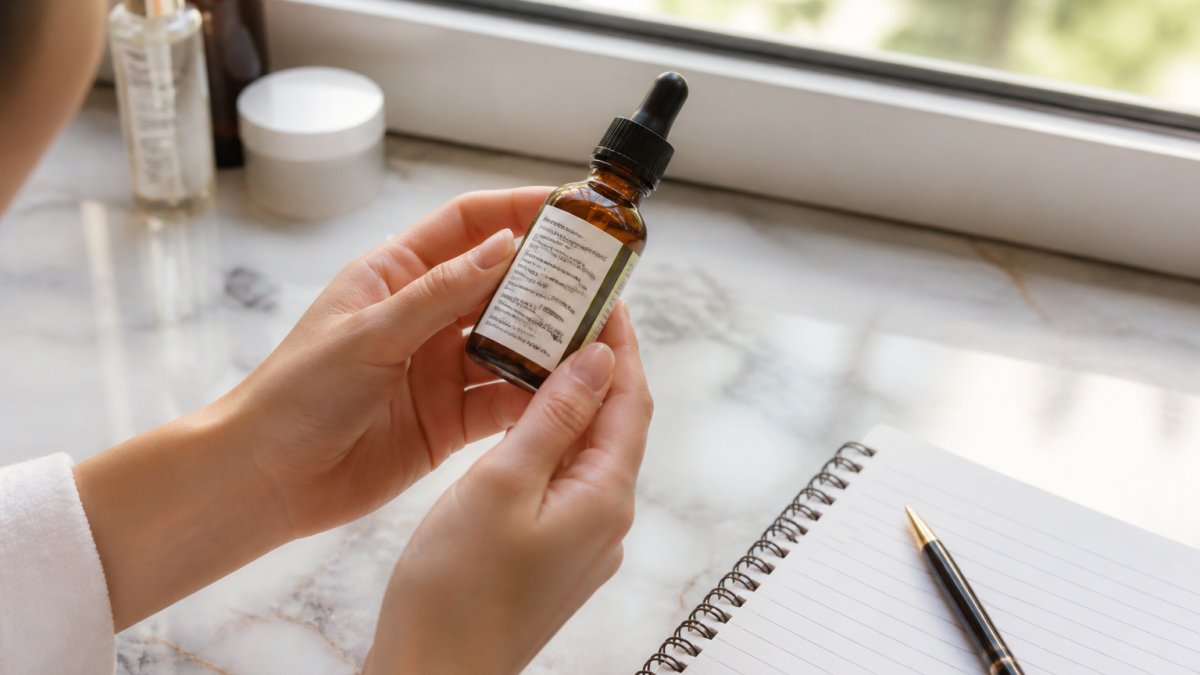
A practical approach:
- Check whether the active appears before or after the 1% marker ingredient
- Look for brands that publish clinical trial results with actual percentages
- Search for independent lab analyses of the specific product
- Read the brand's own FAQ page, which sometimes discloses ranges
- Treat influencer claims about "high concentration" as unverified until a lab confirms it
Bioavailability matters as much as raw percentage. A 20% vitamin C serum that oxidizes before it absorbs performs worse than a well-stabilized 10% formula.
How Stability and pH Balance Limit What Brands Can Disclose
Formulation chemistry genuinely constrains what a brand can promise, and this is where skepticism should soften.
That means the "percentage" a brand could disclose is often meaningless without the surrounding context: the pH, the preservative system, the packaging, the buffer.
The honest takeaway: concentration thresholds matter, but they only matter inside a formula that keeps the active stable long enough to reach your skin.
How to Spot Deceptive Labeling and Marketing Claims
Deceptive labeling usually shows up in the language around the ingredient list, not the list itself. Watch for these patterns:
- "Clinically proven" with no linked study or sample size
- "Contains retinol" when retinol appears after the 1% marker
- Before-and-after photos with different lighting, angles, or makeup
- "Dermatologist tested" instead of "dermatologist recommended"
- Proprietary blends that hide every active behind one name
None of these are illegal on their own. All of them are signals to slow down. The FTC polices deceptive advertising claims, and its guidance on health and advertising claims sets the standard for what counts as misleading, but enforcement is reactive. Your best defense is reading carefully.
How to Fix Skin Barrier Damage When Actives Are Too Strong
If you've overdone it with actives, the fix is subtraction, not addition. Stop the irritating product, simplify to a gentle cleanser and a barrier-supporting moisturizer, and give your skin two to four weeks to recover before reintroducing anything.
Signs you've crossed the line include persistent redness, stinging on application, flaking, and a tight, reactive feeling even from products that used to be fine. When that happens, most dermatologists recommend pausing all exfoliants and retinoids and focusing on ceramides, cholesterol, and fatty acids. The American Academy of Dermatology's guidance on skin care consistently emphasizes gentle cleansing and moisturizing as the foundation of barrier repair.
This connects directly back to the concentration problem. Brands hide percentages, users guess, and guessing is how people end up with a compromised barrier. Knowing how to fix skin barrier damage is the safety net for a labeling system that doesn't give you the numbers.
Consumer Rights and Tools for Ingredient Transparency
You have more leverage than the label suggests.
Use the FDA's own resources. The FDA maintains public guidance on cosmetic labeling and an adverse event reporting system.
Cross-check ingredient names against INCI databases. The International Nomenclature of Cosmetic Ingredients standard is what appears on every U.S. label.
File an FTC complaint when a claim is provably false. The FTC polices deceptive advertising, and its guidance on health and advertising claims sets the standard for what counts as misleading. Enforcement is reactive, which means complaints from consumers are part of how cases get built.
Lean on state consumer protection laws. Every state has some form of unfair or deceptive practices statute.
| Tool or Right | What It Does | How to Use It |
|---|---|---|
| Brand customer service | Can disclose concentration ranges on request | Email a specific percentage question |
| FDA labeling guidance and warning letters | Shows what is and is not permitted | Search warning letters for the brand or category |
| INCI databases | Decode ingredient names and functions | Look up unfamiliar names before buying |
| Third-party lab assays | Verify actual active content | Compare measured results to label claims |
| FTC complaint process | Flags deceptive marketing claims | File when a claim is provably false |
| State consumer protection laws | Provide recourse for misleading labeling | Relevant when a claim becomes a factual misrepresentation |
Consumer pressure has moved the needle before.
Conclusion: What Smart Skincare Shopping Looks Like
The gap between what a label says and what's inside the bottle is a feature of the current system, not a flaw you can fix by reading harder. Trade secrets, the 1% rule, and genuine stability constraints all push brands toward vagueness, and marketing departments happily fill the silence.
What you can control is how you respond. Ask brands direct questions, treat unverified percentage claims as unverified, and prioritize formulas that are stable and well-formulated over ones that simply print a bigger number. Vampire Tx builds its serum around copper peptides and bee venom in a single all-in-one formula, so you're not stacking five products and guessing at each one's concentration. If you want high-performance cellular repair without the luxury markup or the label games, shop now.
Frequently Asked Questions
Are skincare brands legally required to list ingredient percentages?
No. Under FDA cosmetic labeling requirements, brands must list ingredients in descending order of concentration, but they are not required to disclose exact percentages. The only exception is when an ingredient is also a drug active, such as sunscreen filters, which must appear in the Drug Facts panel. This gap is why two serums can list the same ingredients yet deliver very different results depending on the effective concentration of active ingredients used.
What is the 1% rule in skincare labeling?
The 1% rule refers to the labeling convention that once an ingredient drops to 1% or less of the formula, brands may list the remaining ingredients in any order. This means everything after the 1% threshold can be shuffled, making it nearly impossible for consumers to gauge how much of a key active is actually present. It is one of the biggest reasons skincare ingredient percentages stay hidden.
Do brands hide percentages to protect proprietary formulas?
Sometimes, yes. Trade secret protections allow brands to guard exact ratios and proprietary formulas from competitors. But the FDA does not require percentage disclosure for cosmetics in the first place, so many brands simply stay quiet because they can. When you see a proprietary blend on a label, treat it as a signal to look for third-party testing, clinical trials, or transparent sourcing information before assuming the formula is potent.
How can I tell if a product has an effective concentration of actives?
Look for brands that publish stability testing data, pH balance ranges, and clinical trial results. Check whether the active ingredient appears in the first five to seven items on the INCI list. Contact customer service and ask directly about concentration levels. Brands confident in their formulation integrity will answer. If a company dodges the question entirely, that tells you something about their commitment to ingredient transparency.
Sorting real formulation data from marketing noise takes more effort than most people want to spend. Vampire Tx simplifies the decision by combining copper peptides and bee venom in one high-performance serum, so you skip the guesswork of layering actives you can't verify. It's built for people who want visible anti-aging results without paying luxury-brand prices for the same uncertainty. Shop now and lock your skin in its prime.