
Table of Contents
- Why The Ordinary May Not Work for Sensitive Skin
- Building a Gentle Skincare Routine for Sensitive Skin
- How to Repair a Damaged Skin Barrier
- Choosing the Best Serum for Sensitive Skin
- How to Patch Test Skincare Products Safely
- Product-by-Product Substitutions for The Ordinary
- Frequently Asked Questions
Last Updated: October 21, 2026
Why The Ordinary May Not Work for Sensitive Skin
The Ordinary has built a reputation on affordable, ingredient-focused skincare. If you have sensitive skin, many of their products, particularly their active ingredients like retinoids, acids, and high-concentration vitamin C, can trigger redness, irritation, or barrier damage, which is why the ordinary alternative for sensitive skin prioritizes lower concentrations and barrier support.
The core issue isn't that The Ordinary formulates poorly. It's that their products are designed for efficacy at minimal cost, which often means higher active concentrations, minimal buffering, and fewer soothing ingredients. For resilient skin types, this is perfect. For sensitive skin, it's a minefield.
This guide explores why The Ordinary may not suit sensitive skin, and what alternatives, including targeted product substitutions, can deliver results without the irritation. We'll also cover how to repair a damaged skin barrier and select serums that work for reactive skin types.
Building a Gentle Skincare Routine for Sensitive Skin
A gentle skincare routine for sensitive skin prioritizes barrier support over aggressive actives. The goal is to strengthen your skin's protective layer while addressing aging concerns slowly and steadily.
Start with a minimal routine: cleanser, moisturizer, and one gentle serum. Many people assume more steps equal better results, but sensitive skin often improves faster with less.
Choose a non-stripping cleanser, oil cleansers or milk cleansers work well for sensitive skin because they remove makeup and daily grime without disrupting your skin barrier.
When introducing active ingredients, go slow. Add one new product every 2-3 weeks, using it just 2-3 times per week initially. This allows your skin to adapt without overwhelming it.
How to Repair a Damaged Skin Barrier
Barrier damage shows up as persistent redness, dryness, tightness, and increased sensitivity to products that previously felt fine.
The first step is to stop using all active ingredients immediately. This includes retinoids, acids, vitamin C, and peptides. Your barrier needs time to rebuild without additional stress.
Focus instead on barrier-repair ingredients: ceramides, cholesterol, free fatty acids, and centella asiatica. These work together to restore your skin's lipid barrier and reduce inflammation.
Apply a simple routine: gentle cleanser, hydrating toner or essence, barrier-repair moisturizer, and sunscreen.
Once redness fades and tightness resolves, reintroduce actives very gradually. Start with the gentlest option, perhaps a low-dose retinol or mild exfoliating acid, just 1-2 times per week. Monitor your skin closely.
Choosing the Best Serum for Sensitive Skin
The best serum for sensitive skin, and the ordinary alternative for sensitive skin, is not the one with the shortest ingredient list or the word "gentle" on the label. It is the one whose active concentration, pH, vehicle, and preservative system match your skin's tolerance. This section gives you a screening framework you can apply to any serum, including The Ordinary's, without relying on marketing claims.
Ingredient concentration and formulation differences
Concentration is the first filter. For sensitive skin, the practical thresholds most practitioners use are:
- Retinol: start at 0.025%-0.1%; 0.2% and above is where many reactive users report flaking and redness. Encapsulated retinol at 0.1% often feels gentler than free retinol at 0.05% because release is slower.
- Niacinamide: 2%-5% is the well-tolerated range; 10% is where flushing and dryness become common, especially in watery bases.
- Vitamin C (L-ascorbic acid): 10%-15% is the practical ceiling for reactive skin; 20%+ formulas sting and oxidize faster. Derivatives like sodium ascorbyl phosphate are gentler but less studied.
- AHA (glycolic, lactic): 5%-8% for leave-on toners; 10%+ belongs in rinse-off or weekly formats. Lactic acid is generally gentler than glycolic at the same percentage because its larger molecule penetrates more slowly.
- BHA (salicylic acid): 0.5%-1% in a leave-on product is enough for most sensitive acne-prone skin; 2% is the upper limit and often drying.
pH is the second filter. Acids only exfoliate in their free-acid form, which means a lower pH is more effective but also more irritating. A glycolic toner at pH 3.5 will sting more than the same percentage at pH 4.
Formulation is the third filter. A serum with high water content and little oil absorbs fast but can leave skin tight. A serum with ceramides, squalane, or plant oils supports the barrier while delivering actives. For sensitive skin, the creamier or more buffered base is usually the better bet, even if it feels less "clinical."
Fragrance, allergens, and common irritants
Fragrance is the most common cosmetic irritant, and "natural" fragrance from essential oils is not automatically safer. If your skin reacts to many products, start with fragrance-free serums to remove one variable.
Other frequent culprits to screen for:
- Alcohol denat. Drying and disruptive to the barrier at higher concentrations; fine in small amounts in some formulas, but a red flag near the top of the list.
- Essential oils (lavender, citrus, peppermint, eucalyptus): common contact allergens even in "clean" formulas.
- Botanical extracts (witch hazel, citrus extracts, menthol): can sting or sensitize reactive skin.
- Preservatives: parabens are stable and rarely problematic; phenoxyethanol and methylisothiazolinone are more likely to irritate. If you react to many products, preservatives may be the common thread.
A practical screening rule: if a serum contains fragrance, essential oils, or alcohol denat. in the first five ingredients, treat it as higher-risk and patch test before full-face use.
A serum-screening checklist
Before you buy, run the label through these five questions:
- Is the active at a concentration your skin has tolerated before, or lower?
- Does the brand publish pH (for acids) or use encapsulated actives (for retinoids)?
- Is the base hydrating or barrier-supporting rather than purely watery?
- Is it fragrance-free, and are alcohol denat. and essential oils absent or low on the list?
- Can you buy a small size or sample to patch test before committing?
How to Patch Test Skincare Products Safely
Patch testing prevents full-face reactions and helps you identify which ingredients trigger your skin.
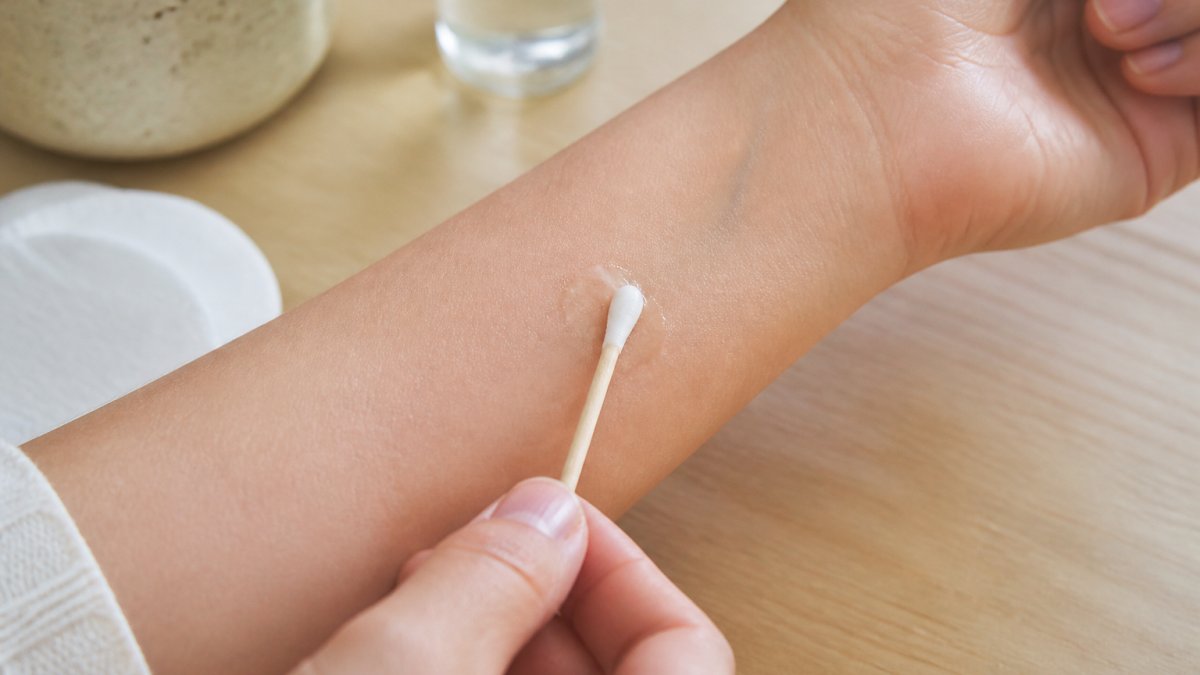
Apply a small amount of the product to your inner forearm or behind your ear, areas with thin, reactive skin similar to your face. Use a cotton swab for precise application.
If no reaction occurs after 48 hours, the product is likely safe for your face.
Keep the patch test area clean and dry. Don't scratch or disturb it, and avoid applying other products to that spot.
Some people experience "purging", temporary breakouts or flaking when introducing a new active ingredient. This is different from an allergic reaction.
Product-by-Product Substitutions for The Ordinary
Most roundups tell you to "switch to a gentler brand" without telling you which product replaces which. That is the gap this section fills: a direct, product-by-product map from popular The Ordinary items to specific alternatives, with the concentration, pH, and formulation differences that actually determine whether sensitive skin tolerates them.
| The Ordinary Product | Why It Can Sting Sensitive Skin | Specific Gentler Alternative | Concentration / pH Difference | Approx. Price (USD) |
|---|---|---|---|---|
| Retinol 0.2% in Squalane | Retinol at 0.2% with no buffer; squalane base is occlusive but not soothing | CeraVe Resurfacing Retinol Serum (encapsulated retinol, ceramides, niacinamide) | Encapsulated retinol delivers gradually; ceramides buffer irritation | ~$20 for 1 fl oz |
| Glycolic Acid 7% Toning Solution | 7% glycolic at low pH; ginseng and aloe don't offset sting | Paula's Choice 5% AHA Exfoliant (or 2% BHA for acne-prone) | Lower AHA concentration, pH ~3.5-4, added soothing agents | ~$34 for 3.3 fl oz |
| Vitamin C 23% Suspension | 23% L-ascorbic acid in a propanediol base; can tingle and oxidize | Timeless 20% Vitamin C + E Ferulic (or 10% for very reactive skin) | Lower L-ascorbic acid load, ferulic acid stabilizes, pH ~3 | ~$25 for 1 fl oz |
| Niacinamide 10% + Zinc 1% | 10% niacinamide can flush and feel drying at high dose | La Roche-Posay Toleriane Double Repair Matte (niacinamide ~4%) | ~4% niacinamide with ceramides and prebiotic thermal water | ~$22 for 1.35 fl oz |
| Salicylic Acid 2% Solution | 2% BHA in an alcohol-adjacent base; drying for reactive skin | Differin Daily Deep Cleanser (0.5% salicylic) or CeraVe Renewing SA Cleanser | 0.5% salicylic in a hydrating cleanser base; shorter contact time | ~$14-$18 for 8 fl oz |
| Hyaluronic Acid 2% + B5 | Multiple HA weights; can feel tacky and pull moisture in dry climates | La Roche-Posay Hyalu B5 Serum (HA + panthenol + madecassoside) | HA paired with barrier-soothing panthenol and centella derivative | ~$40 for 1 fl oz |
| AHA 30% + BHA 2% Peeling Solution | Very high acid load; not appropriate for sensitive skin at all | Dr. Dennis Gross Universal Daily Peel (lower-strength daily format) | Fractional acid doses per pad rather than a 30% mask | ~$88 for 30 treatments |
| Buffet (multi-peptide) | Peptide blend with no barrier lipids; can feel incomplete | Paula's Choice Pro-Collagen Multi-Peptide Booster | Peptides plus ceramides and hyaluronic acid in a creamier base | ~$52 for 0.67 fl oz |
A few practical notes on reading this table:
- Concentration is not the whole story. A 5% glycolic product at pH 3.5 can sting more than a 7% product buffered to pH 4. When in doubt, ask the brand for the pH or check the ingredient list for soothing agents like allantoin, panthenol, or centella.
- Encapsulation matters for retinoids. Encapsulated retinol (as in the CeraVe option) releases more slowly, which is why many sensitive-skin users tolerate it at concentrations that would irritate them in a free-retinol formula.
- Match the vehicle to your skin. If your skin is dry and reactive, a cream or lotion base is usually better tolerated than a watery serum. If you are oily and acne-prone, a gel or light lotion prevents congestion.
- Do not stack substitutes. Replacing three The Ordinary products with three alternatives at once makes it impossible to tell what is working. Swap one product, wait 2-3 weeks, then swap the next.
For acne-prone sensitive skin, the salicylic acid swap is the highest-value change: a 0.5% salicylic cleanser used once daily often clears pores without the sting of a 2% leave-on solution. For anti-aging without retinoid irritation, bakuchiol and copper peptides are reasonable alternatives, but they are not equivalent to retinol in published efficacy, so set expectations accordingly.
Frequently Asked Questions
What is a good alternative to The Ordinary for sensitive skin?
Look for alternatives with minimal ingredients, no fragrance, and lower concentrations of active ingredients. Products with barrier-support ingredients like ceramides and hyaluronic acid work better for sensitive skin than high-strength actives. Brands focused on gentle formulas often avoid the irritants common in The Ordinary's products, such as alcohol denat and essential oils. Always patch test before full application.
How do I introduce a new serum to sensitive skin without causing irritation?
Start with patch testing on your inner forearm for 24-48 hours to check for allergic reaction. If no redness or itching occurs, apply a small amount to your face every other day for the first week, then gradually increase frequency. Watch for signs of purging (small breakouts) versus true irritation (persistent redness, burning, or dryness). If irritation develops, stop immediately and return to your previous routine.
Can people with sensitive skin use active ingredients?
Yes, but with caution. Sensitive skin can tolerate active ingredients at lower concentrations and with longer adjustment periods. Start with gentler actives like niacinamide or low-dose vitamin C before progressing to stronger options like retinol or exfoliating acids. Always use these in combination with barrier-support products like moisturizers and never layer multiple strong actives at once. Patch testing is essential before committing to any active ingredient.
What should I use to repair a damaged skin barrier?
Focus on hydration and barrier-support ingredients: ceramides, cholesterol, fatty acids, hyaluronic acid, and glycerin. Use a gentle cleanser, avoid exfoliating acids temporarily, and apply a rich moisturizer twice daily. Products with centella asiatica or allantoin can reduce redness and support healing. Avoid active ingredients until your barrier recovers, which typically takes 2-4 weeks depending on damage severity. Sunscreen daily prevents further barrier damage.
Sensitive skin doesn't mean you have to choose between results and comfort. The key is matching your products to your skin's actual tolerance level, not following trends or price points. Start with barrier repair, introduce actives slowly at lower concentrations, and patch test everything. When you find products that work, whether from The Ordinary's gentler offerings or from alternatives designed specifically for reactive skin, stick with them. Consistency matters more than complexity.