
Table of Contents
- Why Fine Lines Appear in Your 30s (And How to Prevent Them)
- When to Start Using Retinol: Timing Your Anti-Aging Routine
- How to Protect Skin from Sun Damage Every Day
- The Benefits of Copper Peptides for Skin (and Why They Matter in Your 30s)
- Lifestyle Factors That Prevent Fine Lines: Sleep, Stress, and Diet
- Ingredient Layering Safety: How to Combine Actives Without Irritation
- Budget-Friendly vs. Clinical-Grade Routines: What Actually Works
- Conclusion
- Frequently Asked Questions
Last Updated: September 28, 2026
Why Fine Lines Appear in Your 30s (And How to Prevent Them)
Fine lines in your 30s are not a flaw. They are a signal. Collagen production drops roughly one percent each year after your mid-twenties, and elastin, the protein that snaps skin back into place, starts to fray. This guide from Vampire Tx breaks down exactly how to prevent fine lines in your 30s before they settle in for good.

So what actually changes in your 30s?
- Collagen and elastin decline. Skin loses bounce and starts creasing along expression lines.
- Cellular turnover slows. Dead cells linger, so skin looks dull and lines look deeper.
- Hormonal shifts begin. Estrogen fluctuations can thin the skin and reduce moisture.
- Sun damage surfaces. Photoaging from your teens and twenties starts showing up as fine lines.
When to Start Using Retinol: Timing Your Anti-Aging Routine
Start retinol in your late 20s to early 30s, once or twice a week, and build up slowly. Retinol is a form of vitamin A that speeds up cellular turnover and supports collagen production. It is the most studied ingredient for fine lines, and timing matters more than strength.
- Begin with a low-strength retinol twice a week at night.
- Apply a pea-sized amount to dry skin, then follow with moisturizer.
- Add one more night each week if your skin stays calm.
- Pause if you see peeling, redness, or stinging.
- Always wear broad-spectrum SPF the next morning.
How to Protect Skin from Sun Damage Every Day
Daily sun protection is the single most effective way to prevent fine lines. UV radiation causes most premature aging, a process called photoaging. It breaks down collagen and creates free radicals that drive oxidative stress in the skin.
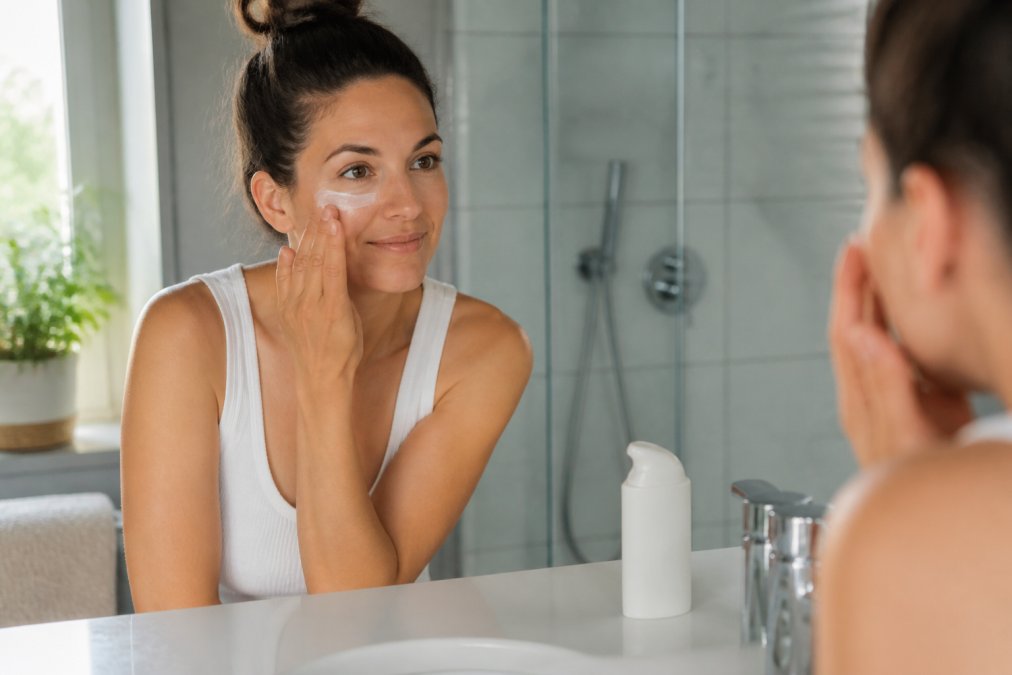
Build the habit with these steps:
- Apply sunscreen as the last step of your morning routine.
- Use a nickel-sized amount for your face and neck.
- Reapply after sweating, swimming, or long sun exposure.
- Add a hat and sunglasses for extra defense.
The Benefits of Copper Peptides for Skin (and Why They Matter in Your 30s)
The benefits of copper peptides for skin come down to repair. Copper peptides are small protein fragments that help support collagen production, elastin, and the skin's natural healing process. In your 30s, when collagen starts slipping, they help your skin hold its firmness.
Lifestyle Factors That Prevent Fine Lines: Sleep, Stress, and Diet
Sleep, stress, and diet shape your skin as much as any serum. When you sleep poorly, your body releases more cortisol, the stress hormone that breaks down collagen and elastin over time. That is why a bad week can show up on your face.
Small lifestyle modifications add up. Try these:
- Sleep on your back. Side sleeping presses lines into your cheeks and chest.
- Get seven to nine hours. This is when skin repairs itself.
- Manage stress. Chronic stress speeds up cellular aging.
- Eat for your skin. Antioxidants from fruit and vegetables fight free radicals.
- Drink water. Hydration supports the skin barrier and reduces transepidermal water loss.
Ingredient Layering Safety: How to Combine Actives Without Irritation
Ingredient layering safety is about order, pH, and patience. The wrong combination, applied too fast or in the wrong sequence, damages your skin barrier and makes fine lines look worse. The right order lets each active do its job without canceling the next one out.
- Cleanse with a gentle, non-stripping wash. If your skin feels tight after cleansing, your barrier is already stressed and actives will sting.
- Treat with water-based serums first, vitamin C, copper peptides, niacinamide, or hydrating humectants like hyaluronic acid.
- Moisturize to seal in hydration and support the barrier. This step is not optional when you use retinol.
- Protect with broad-spectrum SPF in the morning. Everything else is secondary to this step.
Pairings to avoid on the same night
- Retinol + strong alpha hydroxy acids (glycolic, lactic) or beta hydroxy acid (salicylic). Both accelerate turnover. Together they strip the barrier, and irritated skin ages faster, not slower. Alternate nights instead.
- Retinol + benzoyl peroxide. Benzoyl peroxide can oxidize and deactivate many retinoids, so you lose the benefit and add irritation.
- Vitamin C (L-ascorbic acid) + retinol in the same layer. They prefer different pH ranges, vitamin C is most stable in an acidic environment, retinol in a closer-to-neutral one. Split them: vitamin C in the morning, retinol at night.
- Niacinamide + high-dose L-ascorbic acid. This pairing is debated. Many people tolerate it fine; some flush. If you flush, separate them by 15-30 minutes or use one in the morning and one at night.
- Copper peptides + vitamin C or strong acids. Copper peptides work best at a skin-friendly pH and can be destabilized by acidic actives. Keep copper peptides for mornings when you are not using vitamin C, or for nights when you are not using retinol.
Pairings that work well together
- Retinol + niacinamide. Niacinamide supports the barrier and can reduce the redness and peeling that come with starting retinol.
- Vitamin C + sunscreen. Antioxidants do not replace SPF, but they help neutralize the free radicals UV exposure creates.
- Hyaluronic acid + anything. It layers under almost every active and buffers the sting of stronger formulas.
- Copper peptides + moisturizer. No conflict, and the moisturizer reduces the chance of any tingling.
Wait times and application order
You do not need to wait 20 minutes between every step. A common pattern is:
- Apply water-based serums to clean, dry skin and let them absorb for about 60 seconds.
- Apply retinol to dry skin, damp skin increases penetration and irritation.
- Wait 1-2 minutes, then apply moisturizer.
- In the morning, apply vitamin C, wait a minute, then moisturizer, then SPF.
Budget-Friendly vs. Clinical-Grade Routines: What Actually Works
A budget-friendly routine can work as well as a clinical-grade one if the ingredients are right. Price does not equal results. What matters is whether a product contains proven actives at effective levels, whether the packaging protects those actives from light and air, and whether you use it consistently.
Tier 1: Drugstore and mass-market (roughly $15-$40 per product)
This tier covers prevention well. Look for:
- A broad-spectrum SPF 30 or higher. Mineral or chemical, whichever you will wear daily. This is the single most important product in any routine.
- A gentle cleanser. Non-foaming or low-foaming formulas are less likely to strip the barrier.
- A basic moisturizer. Ceramides, glycerin, or hyaluronic acid are the ingredients to look for.
- An over-the-counter retinol. Start at the lowest strength and build up. Encapsulated retinol formulas tend to be gentler than free retinol.
- A vitamin C serum. L-ascorbic acid is the most studied form, but it is unstable. Derivatives like sodium ascorbyl phosphate are more stable and gentler, though often less potent.
What you can skip at this tier: eye creams that are just moisturizer in a smaller jar, and any product whose only active is a botanical extract with no published data behind it.
Tier 2: Mid-range and dermatologist-developed (roughly $40-$120 per product)
This tier buys you better formulation, more stable packaging, and often higher concentrations of proven actives. It is where copper peptides, encapsulated retinaldehyde, and well-formulated vitamin C serums tend to live.
A reasonable mid-range routine:
- Morning: gentle cleanser, vitamin C or copper peptide serum, moisturizer, SPF.
- Night: cleanser, retinol or retinaldehyde, moisturizer.
Tier 3: Prescription and in-office (varies widely; often $50-$500+ per treatment or refill)
This tier is for lines that are already set, or for skin that has not responded to over-the-counter actives after several months of consistent use.
- Prescription retinoids (tretinoin, tazarotene). Stronger and faster than over-the-counter retinol, but also more irritating. They require a prescription and a real adjustment period.
- Botulinum toxin injections. Soften expression lines by relaxing the muscles that cause squinting and frowning. Results typically last a few months and require repeat treatments.
- Laser resurfacing and chemical peels. Improve texture and pigmentation. They involve downtime and cost, and they work best on existing damage rather than as prevention.
- Microneedling. A middle-ground option that some practitioners use to support collagen production with less downtime than resurfacing lasers.
How to decide which tier you need
Ask three questions:
- Are your lines visible at rest, or only when you make an expression? Lines only visible with expression usually respond to prevention and botulinum toxin. Lines visible at rest often need resurfacing or prescription retinoids.
- Have you used a consistent at-home routine for at least three months? If not, fix that first. No in-office treatment replaces daily SPF and a retinoid.
- What is your realistic monthly budget? A $30 sunscreen you reapply daily beats a $200 serum you use twice a week.
For most people in their 30s, a Tier 1 or Tier 2 at-home routine covers prevention. Tier 3 is for correction, not prevention, and it works best when it sits on top of a solid daily routine rather than replacing one.
Conclusion
Preventing fine lines in your 30s comes down to daily habits, not expensive fixes. Sun protection, smart actives, and steady sleep do most of the work.
Frequently Asked Questions
Is it normal to have fine lines at 30?
Yes, it's completely normal. Collagen production naturally declines by about 1% per year after age 20, and by your 30s, cumulative UV exposure and repetitive facial expressions start to show. Fine lines around the eyes and forehead are often the first signs. The good news: starting a consistent routine with sunscreen, retinoids, and antioxidants now can slow further lines and improve existing ones.
Is 30 too late to start using retinol?
No, 30 is an ideal time to start. Retinol boosts cellular turnover and stimulates collagen, which helps prevent fine lines from deepening. Begin with a low concentration (0.1%-0.3%) twice a week at night, then gradually increase as your skin tolerates it. Always pair with moisturizer and daily sunscreen, as retinol increases sun sensitivity. If you're pregnant or nursing, consult your dermatologist first.
What are the most effective ingredients for preventing fine lines?
The most evidence-backed ingredients are broad-spectrum SPF, retinoids (retinol), vitamin C, and copper peptides. Sunscreen prevents UV damage that breaks down collagen. Retinoids speed cell turnover. Vitamin C fights free radicals. Copper peptides support skin repair and firmness. A serum like Vampire Tx combines copper peptides with hyaluronic acid and bee venom to target fine lines and hydration in one step.
Can a simplified skincare routine effectively prevent wrinkles?
Yes, consistency matters more than the number of steps. A simple routine with a gentle cleanser, a multi-tasking serum (like one with copper peptides and hyaluronic acid), a moisturizer, and daily sunscreen can address fine lines, hydration, and protection. Overloading with too many products can irritate your skin barrier. Focus on proven ingredients and use them daily for the best results.