
Table of Contents
- Cellular Repair vs Anti-Aging: What Actually Stops Peeling
- Comparison Table: Cellular Repair vs Anti-Aging Serums
- How to Layer Serums Correctly Without Triggering Peeling
- Skincare Products Causing Peeling: How to Spot the Culprit
- How to Repair the Skin Barrier While Targeting Fine Lines
- Skincare Routine for Women Over 40: Firmness, Elasticity, and Glow
- Realistic Timelines: When You'll See Smoother, Firmer-Looking Skin
- Conclusion: Choose the Approach That Fits Your Skin
- Frequently Asked Questions
Last Updated: October 15, 2026
Cellular Repair vs Anti-Aging: What Actually Stops Peeling
Peeling after a new serum is the most common complaint we hear at Vampire Tx, and it almost always traces back to one mistake: treating cellular repair and anti-aging peeling as the same thing.

The fix is not to abandon actives but to sequence them: repair first, resurfacing second. Here is how the two approaches differ, how to layer them without irritation, and how to repair the barrier while still targeting fine lines.
Comparison Table: Cellular Repair vs Anti-Aging Serums
The table below compares the two approaches across the factors that decide whether your skin peels or thrives.
| Factor | Cellular Repair Approach | Anti-Aging Approach |
|---|---|---|
| Primary goal | Rebuild the skin barrier, support the skin's own renewal signals | Reduce visible fine lines, wrinkles, firmness loss, uneven tone |
| Representative actives | Copper peptides (GHK-Cu), hyaluronic acid, ceramides, niacinamide, panthenol | Retinoids (retinol, tretinoin), Vitamin C (L-ascorbic acid), exfoliating acids (glycolic, lactic, salicylic) |
| Mechanism | Peptides act as signaling molecules that support collagen and elastin production; humectants like hyaluronic acid draw water into the upper layers; ceramides and fatty acids replace barrier lipids | Retinoids accelerate cell turnover and influence gene expression tied to collagen; Vitamin C supports collagen synthesis and neutralizes free radicals; acids dissolve the bonds holding dead cells together |
| Evidence strength | Moderate, peptide and ceramide research is consistent but generally smaller and shorter-term than retinoid trials | Strong for retinoids and Vitamin C; moderate for individual exfoliating acids depending on concentration and pH |
| Typical peeling risk | Low | Moderate to high, especially in the first four to six weeks of a retinoid |
| Best for | Sensitive, depleted, barrier-compromised skin; first-time active users; anyone currently flaking | Resilient skin targeting visible aging; users who have already built tolerance to actives |
| Time to visible results | 2-4 weeks for hydration and comfort | 8-12 weeks for texture and tone; 12-24 weeks for firmness and fine lines |
| Frequency | Daily, morning and night | 2-3 times weekly to start, building slowly |
| Layering position | First, on clean, slightly damp skin | After the repair layer, or on alternate nights |
| Main limitation | Does not resurface; deep wrinkles and sun damage will not fade on peptides alone | High irritation ceiling; can damage the barrier if layered with other actives or used too often |
How to Read the Table
Start with the "peeling risk" row.
The "evidence strength" row is where most marketing overreaches. Retinoids have decades of clinical research behind them, making them the reference standard for visible aging.
The "time to visible results" row is the one people ignore and then quit over.
A serum that combines both functions, like our Vampire Tx Face Serum, simplifies this decision.
How to Layer Serums Correctly Without Triggering Peeling
The rule is simple: apply products from thinnest to thickest, and never layer two strong actives in the same session. Most peeling comes from stacking, not from any single ingredient.
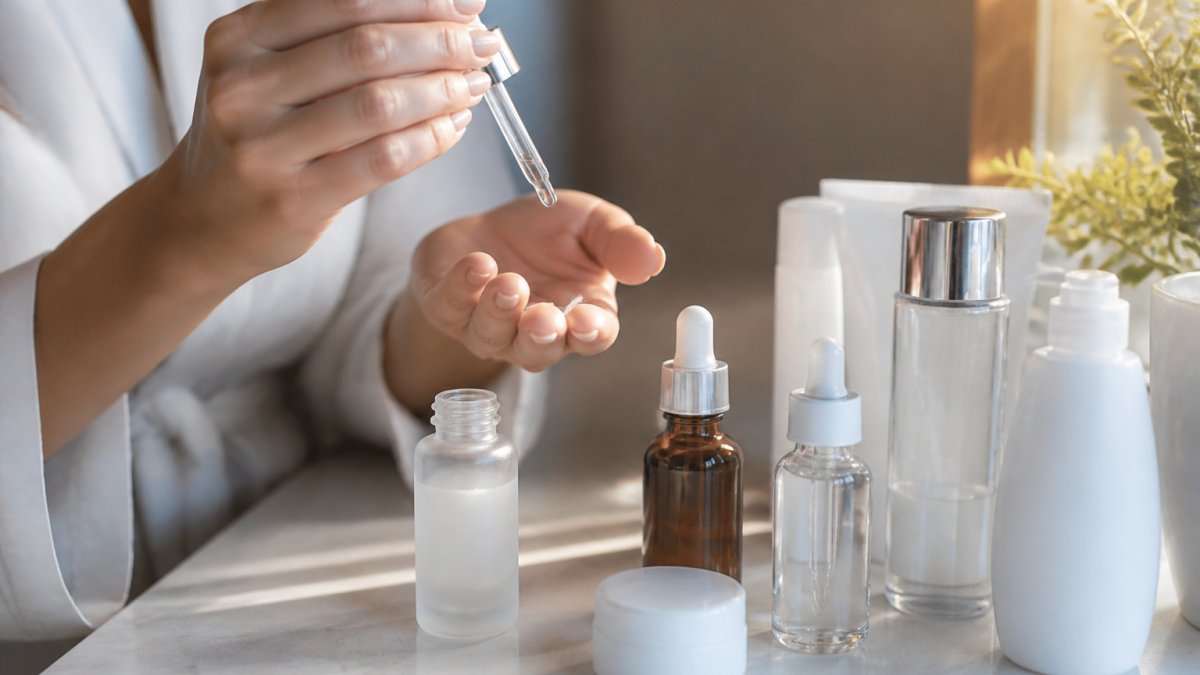
Order Matters: Thinnest to Thickest
Follow this sequence at night:
- Cleanser, patted dry, skin still slightly damp
- Hydrating toner or essence, if you use one
- Water-based serum, such as a peptide or hyaluronic acid formula
- Treatment serum, such as a retinoid, on alternate nights only
- Moisturizer to seal everything in
- Facial oil last, if you use one
Wait about 60 seconds between steps so each layer absorbs and the next does not pill.
Skincare Products Causing Peeling: How to Spot the Culprit
Peeling usually comes from one of four sources: retinoids, exfoliating acids, high-concentration Vitamin C, or a damaged barrier that makes everything sting. Find the culprit by subtracting, not adding: stop all actives for five to seven days, keeping only cleanser, moisturizer, and sunscreen. If peeling stops, reintroduce one active at a time, a week apart.
Expected Exfoliation vs. Irritation: How to Tell Them Apart
This distinction decides whether you push through or stop. Normal exfoliation from a retinoid or acid has a predictable shape:
- It is dry and flaky, not raw or weepy.
- It appears in predictable zones, around the mouth, nose, and chin for retinoids; more evenly across the face for acids.
- It improves week over week rather than escalating.
Irritation that means stop looks different:
- Stinging or burning when you apply anything, including plain moisturizer or water.
- Redness that spreads beyond where you applied the product.
- Swelling, hives, or a rash rather than flaking.
A useful rule: if you have to talk yourself into tolerating it, it is irritation, not exfoliation. Expected exfoliation is annoying but stable. Irritation escalates.
Pattern Recognition by Product Type
- Retinoid peeling appears around the mouth, nose, and chin first, peaks in weeks two to four, and usually fades by week six if you keep frequency steady.
- Acid peeling is uniform across the face and shows up within a day or two, often signaling too high a concentration or too frequent application rather than a true allergy.
- Vitamin C irritation presents as stinging and redness more than visible flaking, particularly with L-ascorbic acid formulas at low pH.
Safe Reintroduction: Patch Testing and Frequency
Before putting a new active back on your face, patch test it: apply a small amount to the inner forearm or behind the ear and wait 24 to 48 hours. This will not catch every reaction, but it catches the obvious ones.
When you reintroduce, start lower and slower than the label suggests:
- Retinoids: once every third night for two weeks, then every other night, then nightly only if your skin stays calm.
- Exfoliating acids: once weekly for two weeks, then twice weekly. Do not chase daily use.
- Vitamin C: every other morning to start, and consider a gentler derivative if L-ascorbic acid stings.
Do not introduce two new actives in the same two-week window. If something goes wrong, you will not know which product caused it.
Products That Should Not Share a Night
The fastest route to a damaged barrier is stacking actives. Keep these apart:
- Retinoid + exfoliating acid
- Retinoid + high-concentration Vitamin C
- Exfoliating acid + another exfoliating acid
If you want both a retinoid and an acid, alternate nights and keep a repair-focused serum or moisturizer on the nights in between.
When to See a Dermatologist
Skincare-induced peeling usually settles within one to two weeks of removing the culprit. See a dermatologist if:
- Peeling is painful, spreading, or accompanied by swelling or oozing.
- You have blisters, hives, or a rash rather than dry flaking.
- Peeling persists beyond two to three weeks after you have stopped all actives.
That is not normal exfoliation and not something to push through. A dermatologist can distinguish irritant contact dermatitis, allergic contact dermatitis, and an underlying skin condition, three problems that look similar but need different treatment.
How to Repair the Skin Barrier While Targeting Fine Lines
You can do both, but repair has to lead. The skin barrier is the outer layer that holds water in and keeps irritants out. When it is compromised, actives penetrate unevenly, which is why the same serum that worked last month now burns. Build your routine around barrier support for two weeks, then reintroduce one anti-aging active.
Barrier-Safe Ingredients to Look For
- Copper peptides (GHK-Cu): support the skin's own repair processes and pair well with barrier recovery.
- Hyaluronic acid: draws water into the upper layers, which reduces the tight, flaky feeling.
- Bee venom: creates a gentle firming sensation; patch test first if your skin runs sensitive.
For a simplified approach, one serum combining copper peptides, hyaluronic acid, and bee venom covers repair and visible firming without layering three bottles. That is the logic behind our Vampire Tx Face Serum x 2, which gives you two bottles to stay consistent through the full adjustment period.

Skincare Routine for Women Over 40: Firmness, Elasticity, and Glow
After 40, priorities shift. Oil production drops, the barrier recovers more slowly, and firmness and elasticity become the visible concerns rather than breakouts. A routine that worked at 30 often feels too harsh at 45.
Here is a structure that holds up:
- Morning: gentle cleanser, peptide serum, moisturizer, sunscreen
- Evening: cleanser, peptide serum, moisturizer
- Twice weekly: a mild exfoliant, only if the barrier is stable
The goal is consistency over intensity: three products used daily beat seven used sporadically, and a steady anti-aging peeling routine beats an aggressive one. An all-in-one serum that handles hydration, firming, and repair lets you skip the layering debate entirely.
Realistic Timelines: When You'll See Smoother, Firmer-Looking Skin
Hydration and barrier comfort improve first, often within one to two weeks. Smoother texture follows around week three to four. Firmer-looking skin and softened fine lines take longer, generally eight to twelve weeks of consistent use.
| Timeframe | What You'll Notice |
|---|---|
| Week 1-2 | Less tightness, reduced flaking, better hydration |
| Week 3-4 | Smoother texture, brighter-looking tone |
| Week 8-12 | Firmer-looking skin, softened fine lines |
| Month 4+ | Maintained results with consistent use |
If you are using a retinoid, expect a four- to six-week adjustment period with some flaking. Copper peptide and bee venom formulas generally do not require that adjustment, which is why they suit people who cannot tolerate retinoids.
Conclusion: Choose the Approach That Fits Your Skin
The peeling problem is not solved by adding more products. It is solved by deciding whether your skin needs repair or resurfacing right now, then sequencing accordingly. Repair first, resurface second, and give it twelve weeks before judging results.
If you want one serum that handles barrier support, hydration, and visible firming without a four-step routine, we built Vampire Tx Face Serum x 3 for exactly that. It combines copper peptides (GHK-Cu), hyaluronic acid, and bee venom in a single step, at a price that does not require a luxury budget.

Frequently Asked Questions
What is a good skincare routine for a 40-year-old woman?
A simple, consistent routine works best: a gentle cleanser, a barrier-supporting serum like Vampire Tx Face Serum, a moisturizer, and sunscreen in the morning. At night, double cleanse if you wear makeup, apply your treatment serum, then seal with a richer cream. Avoid stacking too many active ingredients at once, which is a common cause of peeling and irritation. Introduce new products one at a time so you can tell what is helping and what is hurting.
How should I layer serums in a skincare routine?
Apply from thinnest to thickest. After cleansing, use water-based serums first, then oil-based serums, then moisturizer, and sunscreen last in the morning. Wait about 30 seconds between layers so each product absorbs. If you use a copper peptide serum like Vampire Tx, apply it before heavier creams. Avoid layering strong exfoliating acids directly with retinoids, as that combination often causes peeling and redness.
Can using too many skincare products cause peeling?
Yes. Overloading your skin with multiple active ingredients, such as retinol, glycolic acid, salicylic acid, and vitamin C at the same time, can overwhelm the skin barrier and lead to peeling, redness, and stinging. A simpler routine with one or two targeted products, like a copper peptide and bee venom serum, is often better tolerated. If peeling starts, pause the newest or strongest product and focus on gentle hydration until your skin calms down.
What should I do if my skin peels after using a serum?
Stop the serum for a few days and switch to a bland, hydrating routine. Use a gentle cleanser, a fragrance-free moisturizer, and sunscreen. Avoid exfoliants, retinoids, and hot water. Once peeling stops, reintroduce the serum slowly, maybe every other night, and watch for irritation. If peeling continues or comes with burning, swelling, or a rash, see a dermatologist. Persistent peeling can signal a skin disorder that needs professional care.
Can a minimalist skincare routine help with signs of aging?
A minimalist routine can absolutely help. The key is using high-performance ingredients that address multiple concerns at once, rather than many single-purpose products. A serum with copper peptides and hyaluronic acid, for example, supports firmness, smoothness, and hydration in one step. Fewer products mean less chance of irritation and better consistency, which matters more for visible results than a crowded shelf.