
Table of Contents
- Why Most Anti Age Skin Care Products Disappoint
- The Best Anti-Aging Ingredients for Wrinkles (and What They Actually Do)
- Benefits of Copper Peptides in Skincare: Collagen, Firmness, and Repair
- Building a Skincare Routine for Aging Skin That You'll Actually Follow
- How to Maintain Youthful Skin: Lifestyle Factors That Change the Equation
- Budget vs. Luxury: What You Pay For (and What You Don't)
- Conclusion: Choosing Anti Age Skin Care Products Without the Guesswork
- Frequently Asked Questions
Last Updated: September 29, 2026
Why Most Anti Age Skin Care Products Disappoint
Most anti age skin care products fail because they treat aging skin as one problem when it is several: collagen slows, the barrier weakens, turnover drops, and moisture escapes faster. A product targeting one mechanism will always underwhelm.
At Vampire Tx, we built our formula around that reality. Single-ingredient hero products are fine at what they do, but layering four or five to cover every mechanism is expensive, time-consuming, and a common reason people quit.

Here is what the disappointment usually comes down to:
- Wrong active, wrong strength. A retinol too weak to do anything, or too strong to tolerate.
- No barrier support. Actives that speed turnover without ceramides or hyaluronic acid to hold the skin together.
- No consistency. A routine nobody can stick to produces no results, regardless of what is in the bottles.
The American Academy of Dermatology's guidance on aging skin makes the same point from a clinical angle: visible improvement comes from protecting the skin consistently over time, not from any single product.
That is the standard this guide holds every ingredient and routine to.
The Best Anti-Aging Ingredients for Wrinkles (and What They Actually Do)
The best anti-aging ingredients for wrinkles have a clear mechanism: retinoids accelerate turnover, vitamin C neutralizes free radicals and supports collagen, and hyaluronic acid draws water into the epidermis to plump fine lines. Each has a form, strength, and rules that determine whether it works or wastes your money.
Retinoids, Vitamin C, and Hyaluronic Acid: The Proven Core
Retinoids are vitamin A derivatives that speed cellular turnover and soften fine lines over time. They are the most studied topical treatment for photoaging, but the category is not one ingredient. Tretinoin is the prescription, most potent form; adapalene is OTC and better tolerated; retinol and retinyl palmitate are weaker and must convert in the skin, so a 0.3% retinol and a 0.1% tretinoin are not interchangeable.
The adjustment period is real: redness, flaking, and sensitivity lasting weeks.
What Most Guides Skip: How These Ingredients Interact
The three actives work on different timelines, the most common reason people misjudge a routine. Hydration is immediate, antioxidant protection is preventive, and retinoid-driven turnover takes months. Judging a routine before the slowest ingredient has had time to work is the most common mistake in anti-aging skincare.
A few pairings worth knowing:
- Retinoid plus benzoyl peroxide or strong acids. Increases irritation and can deactivate some retinoids. Alternate nights instead of layering.
- Vitamin C plus niacinamide. Once thought to conflict, but modern formulations generally tolerate the pairing. The old warning came from lab conditions, not real-world use.
- Hyaluronic acid plus anything. Compatible with nearly everything and useful as a buffer under a retinoid.
- Copper peptides plus vitamin C. Often advised to separate, since the acidic environment can affect peptide stability. Morning vitamin C, evening peptides is a common split.
Benefits of Copper Peptides in Skincare: Collagen, Firmness, and Repair
The benefits of copper peptides in skincare center on collagen production, firmness, and repair. Copper peptides are short chains of amino acids bound to copper ions, and the most studied, GHK-Cu, is associated with supporting collagen synthesis and the skin's natural repair processes.
Where copper peptides fit best:
- Firming and elasticity. They support the structural proteins that give skin its bounce.
- Barrier and repair support. They pair well with ceramides and hyaluronic acid in a single formula.
- Tolerance. They can be used alongside or instead of retinoids for sensitive skin.
Building a Skincare Routine for Aging Skin That You'll Actually Follow
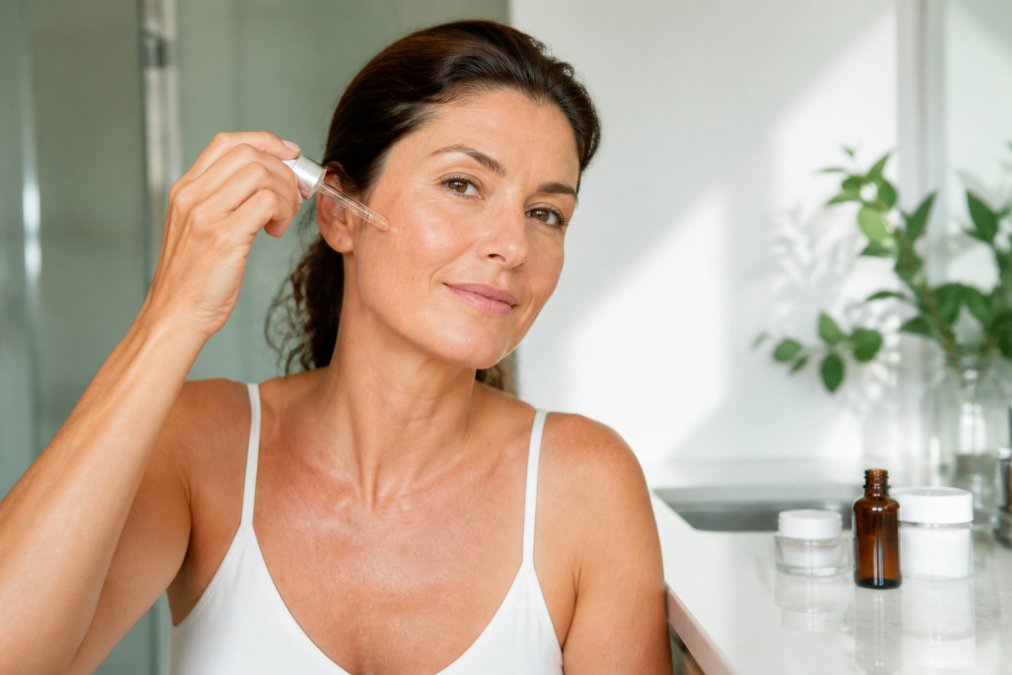
Skincare routine for aging skin works when it is short enough to repeat daily. The most effective routine is not the longest one; it is the one you will still be doing in three months. Two steps morning and night cover every mechanism that matters.
Morning: Protect and Prevent
Morning is about defense: cleanser, antioxidant, sunscreen. Sun protection is the highest-impact step in any anti-aging routine because UV exposure is the primary driver of photoaging, and no active outruns unprotected sun exposure.
- Gentle cleanser
- Vitamin C serum or an antioxidant
- Broad-spectrum SPF 30 or higher, every day, including cloudy ones
Evening: Repair and Rebuild
- Cleanser
- Active treatment (retinoid, copper peptides, or both on alternating nights)
- Moisturizer with ceramides or hyaluronic acid to seal it in
If a four-step routine sounds like more than you will maintain, a single well-formulated serum that combines copper peptides and hyaluronic acid can replace the evening active step, which is exactly the trade-off Vampire Tx's Vampire TX Face Serum is built for at $19.

How to Maintain Youthful Skin: Lifestyle Factors That Change the Equation
How to maintain youthful skin comes down to more than what you put on it. Sleep, sun exposure, smoking, alcohol, diet, and stress all show up on the skin, and no topical fully offsets a lifestyle working against it. The useful version explains what each does to skin structure, which tells you where to spend your effort.
The Factors With the Clearest Impact
- Sun protection. Daily broad-spectrum SPF 30 or higher is the highest-return habit in anti-aging skincare. UV exposure is the primary driver of photoaging and degrades collagen and elastin directly. Reapplication every two hours matters as much as the initial application.
- Sleep. Skin repair and cell turnover peak overnight. Chronic short sleep is associated with visible aging and reduced barrier recovery, dullness, uneven tone, and slower healing.
- Smoking. Nicotine constricts blood vessels and reduces oxygen delivery, while smoke chemicals accelerate collagen and elastin breakdown. The effect is cumulative and largely not reversible with topicals.
- Alcohol. Dehydrates skin and, in excess, is associated with flushing and broken capillaries over time. It also disrupts sleep quality, compounding the effect.
- Diet. Antioxidant-rich foods support the same free-radical defense your serum does. Diets high in added sugar drive glycation, where sugar molecules bind to collagen and stiffen it, contributing to lost elasticity.
- Stress. Elevated cortisol is associated with impaired barrier function and increased oil production. Chronic stress also reduces sleep quality and routine consistency, where most damage compounds.
None of these replaces a topical routine, and a topical routine does not replace them. Lifestyle sets the ceiling; topicals determine how close you get to it.
Menopause and Hormonal Skin Changes
Menopause changes the equation in ways most anti-aging guides skip. Declining estrogen is associated with reduced collagen production, thinner skin, increased dryness, and slower wound healing. Some estimates put the drop in skin collagen in the first several years after menopause as substantial, which is why the routine that worked at 35 often stops working at 52.
Budget vs. Luxury: What You Pay For (and What You Don't)
Budget and luxury anti age skin care products often contain the same proven actives. The price gap usually reflects packaging, fragrance, brand positioning, and marketing spend, not a better ingredient. Retinol is retinol, and copper peptides are copper peptides, whether in a $19 bottle or a $190 one.
What you actually pay for at the luxury end:
| What You're Paying For | Budget Formulas | Luxury Formulas |
|---|---|---|
| Proven actives (retinoids, vitamin C, peptides) | Usually present | Usually present |
| Fragrance and elegant texture | Often skipped | Common |
| Packaging and brand positioning | Basic | Premium |
| Concentration and delivery system | Varies | Varies |
| Price per ounce | Lower | Much higher |
The most expensive product in your routine is rarely the one doing the most work. Sunscreen and a consistent active do more than any premium cream.
Conclusion: Choosing Anti Age Skin Care Products Without the Guesswork
The challenge with anti age skin care products is that the market rewards novelty over mechanism. New ingredients launch every year, and the proven ones, retinoids, vitamin C, hyaluronic acid, and copper peptides, quietly keep doing the work.
Frequently Asked Questions
What is the best anti-aging product that really works?
There's no single miracle product, but the evidence points to a few workhorses: retinoids, vitamin C, SPF, and copper peptides. Copper peptides (GHK-Cu) support collagen production and skin firmness, while retinoids speed cellular turnover. A serum that combines copper peptides with hydrating ingredients like hyaluronic acid can simplify your routine. Vampire TX Face Serum ($19) pairs copper peptides and bee venom for firmness and hydration in one step.
How do copper peptides and bee venom benefit aging skin?
Copper peptides are small chains of amino acids bound to copper. They support collagen production, skin elasticity, and the skin barrier, which can soften fine lines over time. Bee venom is used in some anti-aging products for its ability to temporarily smooth the look of wrinkles by increasing blood flow to the surface. Together, they target firmness and texture without the irritation that can come with prescription-strength retinoids.
At what age should you start using anti-aging products?
Most dermatologists suggest starting in your late 20s to early 30s, when collagen production begins to decline by about 1% per year. That doesn't mean you need a 10-step routine. A simple antioxidant serum in the morning, a retinoid or peptide serum at night, and daily SPF are enough to start. If you're already seeing fine lines, it's not too late; copper peptides and retinoids can still improve skin texture and firmness.
I have sensitive skin. Can I use copper peptides and bee venom?
Copper peptides are generally well-tolerated, even by sensitive skin, because they support the skin barrier rather than stripping it. Bee venom can cause a temporary tingling or warming sensation, which some people mistake for irritation. If your skin is reactive, patch-test on your inner arm first. Vampire TX Face Serum is formulated to be gentle enough for regular use, but always introduce one new product at a time.