
Table of Contents
- Why Your Skin Changes in Your 50s
- Essential Anti-Aging Ingredients That Deliver Results
- Best Anti-Aging Serums for Your 50s
- Building a Simple Routine That Works
- Sun Protection and Preventing Further Damage
- How to Maintain Youthful Skin Long-Term
- Conclusion
- Frequently Asked Questions
Last Updated: September 19, 2026
Why Your Skin Changes in Your 50s
Your skin in your 50s is fundamentally different from what it was at 30, and the reasons go deeper than surface-level aging. Three interconnected processes accelerate skin changes during this decade: hormonal shifts, cellular slowdown, and cumulative environmental damage.
The Hormonal Reality: Estrogen and Skin Barrier Function
For women, menopause and the years leading up to it trigger a dramatic drop in estrogen production. This isn't just a hot-flash issue, it directly impacts skin. Estrogen supports the skin barrier by regulating sebum production, maintaining hyaluronic acid levels, and preserving the lipid matrix that holds moisture in. As estrogen declines, the skin barrier becomes compromised: it loses water faster, becomes more reactive to irritants, and struggles to repair itself.
The result is visible within months. Skin that was once resilient becomes dry, reactive, and prone to sensitivity. Products that worked for decades suddenly cause irritation. This is why a 50-year-old's skin often feels fundamentally different, it is. The barrier function has shifted.
Men experience a slower, more gradual decline in testosterone, which also supports skin firmness and barrier health. The effect is less dramatic but follows the same pattern: reduced barrier resilience and slower repair.
Understanding this hormonal component is critical because it explains why standard routines often fail when it comes to anti-aging for 50s. You're not just fighting fine lines; you're rebuilding a compromised barrier while addressing collagen loss simultaneously.
Collagen Loss and Skin Structure
Collagen production declines roughly 1% per year after age 30, but the rate accelerates in your 50s, particularly for women post-menopause. Collagen provides the structural scaffolding that keeps skin firm and plump. As it breaks down faster than your body can replace it, skin loses volume, fine lines deepen, and the overall texture becomes uneven.
This isn't inevitable decline, it's a shift that calls for a different approach. Many people keep using the same routine they've relied on for decades. That's often where the trouble starts. Your skin's needs have changed, and your products need to match.
Cell Turnover and Skin Texture
Cell turnover, the rate at which your skin sheds dead cells and generates new ones, slows significantly in your 50s. At 20, skin cells turn over every 28 days. By 50, that cycle stretches to 40-60 days or longer. Dead cells accumulate on the surface, making skin look dull, rough, and uneven. Fine lines appear more pronounced because there's less plump, fresh skin underneath.
This slowdown also means your skin takes longer to respond to treatments. Ingredients that showed results in your 30s may work more slowly now, not because they're less effective, but because your skin's natural renewal process has slowed.
The Cumulative Effect of Sun Exposure
By your 50s, your skin has absorbed decades of UV damage. This damage accumulates in the form of age spots, uneven pigmentation, broken capillaries, and deep wrinkles. Sun exposure breaks down collagen and elastin, accelerates cell damage, and triggers inflammation. The damage is often invisible until your 50s, when it suddenly becomes visible all at once.
The good news: targeted ingredients and a simplified routine designed for this specific stage of life can deliver visible results. You don't need a 10-step regimen or luxury price tags. What matters is choosing ingredients proven to address what actually happens to skin in your 50s, barrier repair, collagen support, and cellular renewal, and using them consistently.
Essential Anti-Aging Ingredients That Deliver Results
Not all anti-aging ingredients are created equal. The ones that move the needle address the core problems: loss of firmness, uneven texture, and weakened hydration. Here's what the science backs, and critically, how to layer them safely in skin that's more reactive than it was at 30.
Retinoids and Retinol: The Gold Standard
Retinoids remain the most effective anti-aging ingredient available. They accelerate cell turnover, boost collagen production, and smooth fine lines and wrinkles. If you're serious about anti-aging for your 50s, retinoids belong in your routine.
The difference between retinol, retinaldehyde, and prescription retinoids matters. Retinol is gentler and more accessible. Prescription retinoids like tretinoin work faster but require adjustment. For most people in their 50s, a stabilized retinol or retinaldehyde offers the best balance of efficacy and tolerability.
Start low and build tolerance. Many people rush into high concentrations and experience irritation, then abandon the ingredient entirely. A better approach: begin with a low concentration (0.25-0.5%) once or twice weekly, then increase frequency over 4-6 weeks. Your skin will adapt, and results compound over time.
Copper Peptides for Skin Repair
Copper peptides (GHK-Cu) work differently than retinoids. They signal your skin to increase collagen and elastin production while supporting the skin barrier. For skin in your 50s that's lost firmness and elasticity, copper peptides address the underlying structural problem.
The research on peptides shows they improve skin firmness and reduce the appearance of fine lines (Peptides: Emerging Candidates for the Prevention and Treatment of Skin Senescence: A...). They're also well-tolerated by sensitive skin, making them ideal if you can't use retinoids or prefer a gentler approach. Copper peptides layer well with other ingredients, so you can combine them with retinol or vitamin C without conflict.
Many people overlook peptides because they're less famous than retinol. That's a mistake. For visible improvement in skin elasticity and firmness, peptides deliver measurable results, especially when used consistently over 8-12 weeks.
Hyaluronic Acid and Ceramides for Hydration
Your skin barrier in your 50s needs reinforcement. Hyaluronic acid holds water in the skin, plumping fine lines and improving texture. Ceramides repair the lipid barrier, preventing moisture loss. Together, they're non-negotiable for aging skin.
The mistake most people make: they use hyaluronic acid alone. It works best when paired with an occlusive moisturizer that seals hydration in.
Ingredient Layering Safety: What Works Together and What Doesn't
In your 50s, your skin is more reactive than it was at 30. Combining the wrong actives can trigger irritation, redness, and barrier damage, undoing the benefits you're trying to achieve. Here's a clear guide to safe combinations:
Safe to combine:
- Retinol + Hyaluronic Acid + Ceramides (the core trio)
- Retinol + Copper Peptides (peptides buffer retinol irritation)
- Vitamin C + Hyaluronic Acid + Ceramides
- Niacinamide + Any other active (niacinamide is universally compatible and actually reduces irritation)
- Copper Peptides + Vitamin C (both support collagen; no conflict)
Avoid combining:
- Retinol + Vitamin C in the same step (both are potent; apply Vitamin C in the morning, retinol at night)
- Retinol + AHAs/BHAs (both increase cell turnover; risk of over-exfoliation and barrier damage)
- Multiple retinoid products (retinol + tretinoin + retinaldehyde in the same routine causes irritation)
- Benzoyl Peroxide + Retinol (benzoyl peroxide oxidizes and deactivates retinol)
Proceed with caution:
- Retinol + Niacinamide: Once considered problematic, modern research shows they're compatible. However, if your skin is very sensitive, introduce them on alternate nights initially.
- Vitamin C + Niacinamide: Both are stable together, but high concentrations of both can be irritating. Use moderate concentrations.
Best Anti-Aging Serums for Your 50s
A high-performance serum simplifies your routine while delivering concentrated active ingredients. The best serums for your 50s combine multiple proven ingredients in stable, effective formulations.
Building a Simple Routine That Works
Here's the framework:
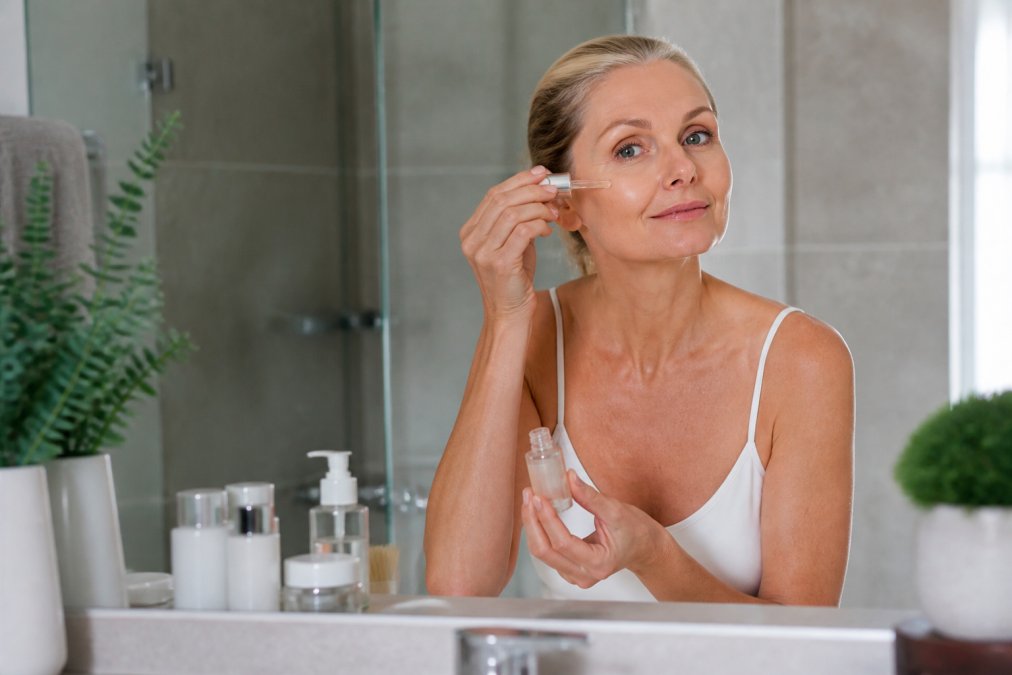
Step 1: Cleanse, Use a gentle cleanser that doesn't strip your skin barrier. Cream cleansers or micellar water work well for mature skin.
Sun Protection and Preventing Further Damage
Sun damage is the fastest path to accelerated aging. UV exposure breaks down collagen, triggers hyperpigmentation, and deepens wrinkles. After 50 years of sun exposure, your skin shows the cumulative damage. The good news: preventing further damage stops the clock.
How to Maintain Youthful Skin Long-Term
Skin in your 50s responds well to consistency and patience. The ingredients that work now will continue working if you stick with them. Most people see their best results after 12-16 weeks of consistent use.
Conclusion
Effective anti-aging for 50s doesn't require complexity or luxury prices. It requires the right ingredients, retinoids for cell turnover, peptides for firmness, hyaluronic acid and ceramides for hydration, applied consistently. A simplified routine with proven actives outperforms a complicated one every time.
Frequently Asked Questions
What ingredients should I look for in anti-aging products for my 50s?
Focus on retinoids (like retinol), copper peptides, hyaluronic acid, ceramides, vitamin C, niacinamide, and peptides. Retinoids boost cell turnover and collagen production. Copper peptides support skin elasticity and firmness. Hyaluronic acid and ceramides strengthen your skin barrier and improve hydration. These ingredients address fine lines, wrinkles, and loss of elasticity, the main concerns in your 50s. Start with one or two and layer carefully to avoid irritation.
Do anti-aging serums really work for mature skin?
Yes, when formulated with clinical-grade ingredients. Serums penetrate deeper than creams because of their smaller molecular structure, delivering active ingredients directly to where they're needed. A high-performance serum with copper peptides and bee venom can improve skin texture, firmness, and hydration. Results depend on consistency, ingredient quality, and your skin's baseline condition. Deep wrinkles may need combination therapy (serum plus retinoid plus sun protection) rather than one product alone.
How often should I use anti-aging products in my 50s?
Most anti-aging serums work best with daily use, morning and evening. Retinoids typically start 2-3 times per week, then increase to daily use as your skin builds tolerance. Sun protection (SPF 30+) is non-negotiable every single day to prevent photoaging and further damage. Moisturizers and supporting products should also be used twice daily. Consistency matters more than intensity; using effective products daily beats using strong products sporadically.
Can a single serum handle multiple signs of aging, or do I need a full routine?
A high-performance serum with multiple active ingredients can address wrinkles, fine lines, firmness, and hydration simultaneously. However, to maximize results, layer it with a retinoid (for cell turnover), a moisturizer (to support your skin barrier), and daily SPF 30+ (to prevent further photoaging). This doesn't mean expensive, a targeted serum, basic moisturizer, and sunscreen cost far less than luxury multi-product routines while delivering stronger results through proper ingredient layering.