
Table of Contents
- Why Stop Using Luxury Skincare Brands: The Markup Reality
- Luxury vs Drugstore Skincare Comparison: What You're Actually Paying For
- Are Expensive Face Serums Worth the Money? The Diminishing Returns Threshold
- How to Build a Minimalist Skincare Routine That Actually Works
- Dermatologist-Led De-Influencing and the Shift to Evidence-Based Skincare
- Skin Fasting and Sustainability: When to Stop Using Expensive Products
- Conclusion: Break Up With the Markup, Not Your Skin
- Frequently Asked Questions
Last Updated: September 11, 2026
Why Stop Using Luxury Skincare Brands: The Markup Reality
Luxury skincare is a pricing strategy wrapped around a cream, and the markup rarely reflects what the formula does for your skin. This guide breaks down exactly where your money goes, which ingredients justify their cost, and when it makes sense to stop using luxury skincare brands altogether.
Here's the uncomfortable math. Most prestige creams share the same base of water, glycerin, and emulsifiers you'll find in a drugstore jar. What separates them is fragrance, packaging, and the story printed on the box. According to the FDA's guidance on cosmetic labeling and ingredient disclosure, cosmetics are not required to prove efficacy before they reach shelves, which means "clinically inspired" can mean almost anything. That gap between marketing language and measurable results is where luxury pricing lives.
Below, we'll show you how to spot the markup, which actives earn their place, and how to build a routine that targets aging without the prestige premium.
Luxury vs Drugstore Skincare Comparison: What You're Actually Paying For
A luxury vs drugstore skincare comparison usually comes down to three cost buckets: marketing markup, packaging, and brand prestige. The formula itself is often the smallest line item.
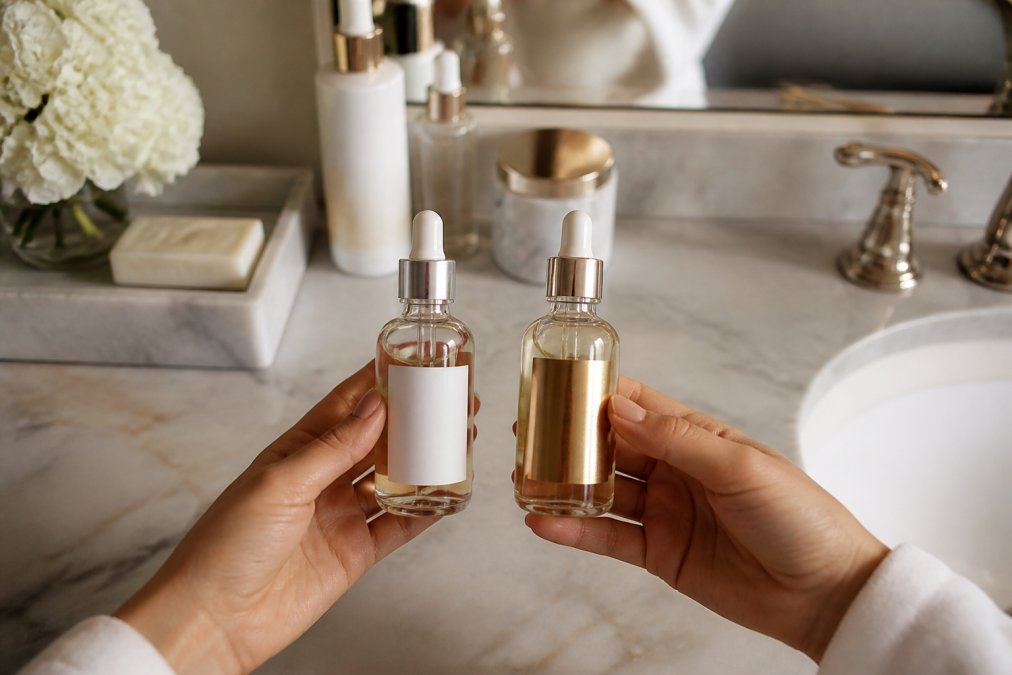
Marketing Markup and Brand Prestige
Marketing markup is the portion of a price that pays for advertising, celebrity campaigns, and retail counter space rather than the ingredients inside the jar. A common mistake is assuming a higher price signals a higher concentration of actives. In practice, it usually signals a bigger media budget. The FTC's rules on advertising claims require companies to substantiate what they say, but "reduces the appearance of fine lines" is a low bar to clear. Brand prestige does real work here: it makes you feel the product is working before you've seen a single result.
Rare Botanical Extracts vs. Proven Actives
Rare botanical extracts sound exotic and often appear in tiny amounts, sometimes below the level needed to do anything measurable. Proven actives, by contrast, have decades of research behind them: retinoids, vitamin C, niacinamide, and peptides. The thing nobody tells you about rare extracts is that many are included for the label, not the skin. Formulation stability matters more than the story, because an unstable active degrades before it ever reaches your face.
The sourcing reality behind the story. A plant extract that appears on a label at "0.1%" is not a dose, it is a signature. Most botanical actives need a defined concentration range to produce a measurable effect, and the same plant can vary wildly in potency depending on where it was grown, when it was harvested, and how it was extracted. A cold-pressed extract from a small batch and a standardized extract from a commercial supplier can share a name and behave nothing alike. That variability is exactly why clinical formulas lean on synthesized or standardized actives: the dose is reproducible batch to batch, and the label means something.
What to check before you pay for a rare ingredient.
- Standardization. Does the brand state the extract is standardized to a specific compound percentage, or just list the plant name?
- Position on the ingredient list. Ingredients are listed in descending order of concentration (with fragrance and actives under 1% allowed to appear in any order after that point). If a hero botanical sits near the bottom, the dose is likely cosmetic.
- Delivery format. An antioxidant-rich botanical in an opaque, airless pump survives longer than the same extract in a clear jar exposed to light and air.
- Sourcing transparency. Brands that can name the region, the supplier, and the harvest method are usually the ones treating the ingredient as a functional active rather than a marketing prop.
The trade-off worth naming. Rare botanicals are not automatically useless, some, like green tea polyphenols and certain standardized algae extracts, have real antioxidant and soothing data behind them. The problem is the price premium attached to scarcity rather than efficacy. You can often get the same functional benefit from a well-studied, widely available active at a fraction of the cost, which is the core of the diminishing-returns argument in the next section.
Are Expensive Face Serums Worth the Money? The Diminishing Returns Threshold
Expensive face serums are worth the money only up to the point where added cost stops adding benefit. That point is the diminishing returns threshold, and most luxury brands cross it deliberately.
Once a formula delivers a proven active at an effective concentration, with stable packaging and a delivery system that supports topical absorption, spending more buys prestige rather than performance. The price-to-value ratio flattens hard at that line. What most reviews miss is that a serum costing several times more than a clinical alternative rarely outperforms it on skin health metrics. It may feel more luxurious, absorb more elegantly, and smell better, but those are sensory wins, not dermal repair.
How to Build a Minimalist Skincare Routine That Actually Works
A minimalist skincare routine is a short, consistent set of steps built around proven actives rather than a shelf full of products. Fewer, better-formulated steps outperform a ten-product regimen almost every time.
The Three-Step Core: Cleanse, Treat, Protect
The three-step core covers everything skin actually needs. A gentle cleanser removes debris without stripping the skin barrier. A treatment step delivers your actives. A sunscreen protects against photoaging, which is the single largest driver of visible aging. Everything else, toners, essences, and layering rituals, is optional. Routine optimization means removing steps that don't earn their place, not adding more.
Ingredient Concentration and Bioavailability Over Brand Names
Ingredient concentration and bioavailability decide whether a product works, not the name on the bottle. Bioavailability is the share of an active that actually reaches living skin cells in a usable form. A formula can list a hero ingredient and still deliver almost none of it if the concentration is too low or the delivery system is poor. This is where cosmeceuticals separate themselves from pure cosmetics: they pair proven actives with formats designed for topical absorption.
| Step | Purpose | What to Look For | Frequency |
|---|---|---|---|
| Cleanse | Remove debris, protect skin barrier | Gentle, non-stripping surfactants | Twice daily |
| Treat | Deliver proven actives | Named actives at effective concentration | Once daily to start |
| Protect | Prevent photoaging | Broad-spectrum sunscreen | Every morning |
Dermatologist-Led De-Influencing and the Shift to Evidence-Based Skincare
Dermatologist-led de-influencing is the pushback against hype-driven buying, led by clinicians who tell patients to drop products that don't do anything. The shift toward evidence-based skincare is the same idea with a research backbone.
This is a real change in how people shop. Consumers now ask for the study, the concentration, and the mechanism before they ask for the brand. Consumer transparency has become a selling point rather than a nice-to-have, and product discontinuation announcements now trigger genuine relief as often as disappointment. The American Academy of Dermatology's public guidance on skin care keeps pointing back to the fundamentals: sunscreen, gentle cleansing, and proven actives. When clinicians de-influence, they're usually just repeating that list.
Skin Fasting and Sustainability: When to Stop Using Expensive Products
Stop using an expensive product when it stops earning its place: no visible benefit after a full cycle, a reaction your barrier can't tolerate, or a price that no longer matches the result. Skin fasting, the practice of periodically simplifying to a bare-bones routine, helps you find out which products were actually doing the work.
The sustainability angle most reviews skip. The environmental cost of a luxury skincare product is rarely in the formula, it is in the packaging and the supply chain around it. A single prestige cream can arrive in a glass jar, a plastic inner lid, a foil seal, a printed outer carton, a cellophane wrap, and a branded shopping bag. Glass is recyclable in theory, but mixed-material pumps, droppers, and airless dispensers usually are not accepted in curbside programs because they combine plastic, metal, and sometimes silicone in a single unit. That means the most "premium" packaging is often the least recyclable.
Where the sourcing cost lands. Rare botanical extracts frequently come from small, geographically limited harvests. When demand spikes, those supply chains can be pressured toward overharvesting or toward substitution with cheaper look-alike species that carry the same label name but not the same chemistry. Brands that publish supplier audits and harvest-sustainability commitments are the exception, not the rule. If a product's entire story is a rare plant, ask what happens to that plant when the product sells out.
A practical framework for when to walk away.
- The full-cycle test. Give a new active a realistic window, most dermatologists suggest several weeks to a few months, before judging it. If nothing changes, the product is not earning its price.
- The barrier test. If a product causes persistent redness, peeling, or stinging that does not resolve with reduced frequency, it is not a "purge." It is a mismatch.
- The price-to-result test. If a simpler, better-formulated alternative delivers the same visible outcome, the premium is no longer justified.
- The reformulation test. When a product is discontinued or reformulated, treat it as a natural checkpoint to reassess rather than a reason to panic-buy.
What skin fasting actually does. Stripping a routine down to a gentle cleanser, a single treatment, and sunscreen for a few weeks does two things: it lets an irritated barrier recover, and it isolates which products were genuinely contributing. Most people find that two or three products were doing the work and the rest were ritual. That is the same conclusion the de-influencing movement reaches from the clinical side, fewer, better-chosen products beat a crowded shelf.
The honest trade-off. Simplifying is not free of compromise. A minimalist routine may mean giving up the sensory experience, the texture, the scent, the ritual, that made skincare enjoyable. That is a real loss, and it is worth naming. The goal is not to make skincare joyless. It is to make sure the joy is not the only thing you are paying for.
Conclusion: Break Up With the Markup, Not Your Skin
The hard part isn't spotting the markup. It's accepting that a simpler routine can outperform the one you've invested in for years, and then rebuilding around actives that actually reach your skin. Vampire Tx offers a single serum fusing copper peptides and bee venom to support high-performance cellular repair and a simplified, all-in-one routine, without the luxury markup. If you're ready to stop paying for prestige and start paying for results, shop now at Vampire Tx and lock your skin in its prime.
Frequently Asked Questions
Does expensive skincare really make a difference compared to drugstore options?
Not necessarily. Price often reflects marketing, packaging, and brand prestige rather than ingredient quality. A $200 serum and a $30 serum can both contain the same active ingredients at similar concentrations. What matters is the formulation, the concentration of proven actives like copper peptides or retinoids, and whether the product addresses your specific skin concerns. Focus on the ingredient list, not the price tag.
How can I build a minimalist skincare routine without spending a fortune?
Start with three core steps: a gentle cleanser, one treatment serum with proven actives, and a broad-spectrum sunscreen. That's it. You don't need ten products. Look for multi-tasking formulas to address multiple signs of aging in one step. This approach saves money and reduces the risk of irritation from layering too many products.
What are the signs that a skincare product is overpriced?
Watch for vague claims like 'rare botanical extracts' without naming the ingredient or its concentration. Check if the product relies on brand prestige or celebrity endorsements rather than clinical data. If the packaging costs more than the formula, or if the brand spends heavily on influencer marketing, you're likely paying a markup. Transparency about ingredient percentages is a good sign of value.
What ingredients should I look for instead of brand names?
Prioritize proven actives: copper peptides for collagen stimulation and dermal repair, retinoids for photoaging, vitamin C for brightening, and hyaluronic acid for hydration. Look for ingredients backed by evidence-based skincare research, not just trendy names. Formulation stability and bioavailability matter more than the brand on the label.