
Table of Contents
- The Real Cost of Switching Skincare Brands
- Does Your Skin Actually Get Used to Products?
- Signs Your Skincare Routine Is Not Working
- How Long to Test New Skincare Before Deciding
- Purging vs. Reaction: The Critical Diagnostic
- How to Transition to New Skincare Products Safely
- When Switching Makes Sense: A Framework for Smart Decisions
- Frequently Asked Questions
Last Updated: September 20, 2026
The Real Cost of Switching Skincare Brands
Every time you switch skincare brands, your skin enters unfamiliar territory. New formulations mean new active ingredients, new pH balances, and new potential reactions. The question isn't whether switching is possible, it's whether the payoff justifies the adjustment period and the risk of temporary setbacks.
Most people underestimate what happens when you introduce a completely new product line. Your skin barrier has adapted to your current routine. It knows how to process the ingredients you're using. When you swap brands entirely, you're asking your skin to recalibrate. That recalibration takes time, and during that window, breakouts, irritation, or dryness can emerge. This is the hidden cost nobody talks about before they switch.
The financial impact matters too. If you're testing a new brand and it doesn't work, you've invested money in products you can't use. Many people end up maintaining two routines simultaneously, their old one and their new one, which doubles their spending while they figure out if the switch is worth it. At Vampire Tx, we understand that switching skincare brands is a real decision with real consequences.
Does Your Skin Actually Get Used to Products?
Your skin doesn't develop immunity to skincare products the way your body develops immunity to medications. What happens instead is far more nuanced.
Skin cells turn over roughly every 28 days, though this timeline varies by age, skin type, and individual biology. During this cycle, your skin adjusts to the ingredients you're applying. Your skin barrier, the outermost protective layer, learns to process specific actives and stabilizes around them. This isn't tolerance in the clinical sense. It's adaptation.
When you use a product consistently, your skin stops reacting to it as "foreign." Redness fades. Irritation subsides. This feels like the product stopped working, but what's actually happening is that your skin has normalized. The ingredient is still active at the cellular level. Your skin is simply no longer in a state of adjustment.
This matters when you're deciding whether to switch. If your current routine feels less effective than it did three months ago, the product itself probably hasn't changed. Your skin has adapted to it. That's different from the product failing. Switching brands might feel like a reset, but you'll face the same adaptation cycle with your new routine.
Signs Your Skincare Routine Is Not Working
Before you switch brands, identify whether your routine is actually failing or whether your skin has simply adapted to it.
Visible breakouts that persist beyond two weeks suggest a mismatch between your products and your skin. This is different from the temporary congestion that happens during a transition. Persistent breakouts mean something in your routine is actively irritating your skin or clogging your pores. That's a legitimate reason to change.
Excessive dryness or tightness that doesn't improve with hydration signals that your products are stripping your skin or that your barrier is compromised. Flaking, sensitivity to other products, or a tight feeling even after moisturizer suggests your routine isn't supporting your skin's health. This is worth addressing by switching products or adjusting your approach.
Visible signs of aging worsening rather than improving, deeper wrinkles, more pronounced texture issues, or loss of firmness, can indicate that your active ingredients aren't strong enough for your skin's needs. If you've been using the same routine for over six months and you're seeing regression instead of improvement, your products may not be delivering the results you need.
Conversely, if your skin looks clear, feels hydrated, and shows visible improvement in fine lines or texture, your routine is working. Feeling like you should switch just because you're bored or curious is different from having a legitimate skincare problem.
How Long to Test New Skincare Before Deciding
Testing new skincare requires patience, but there's a science to knowing when you have enough data to make a decision.
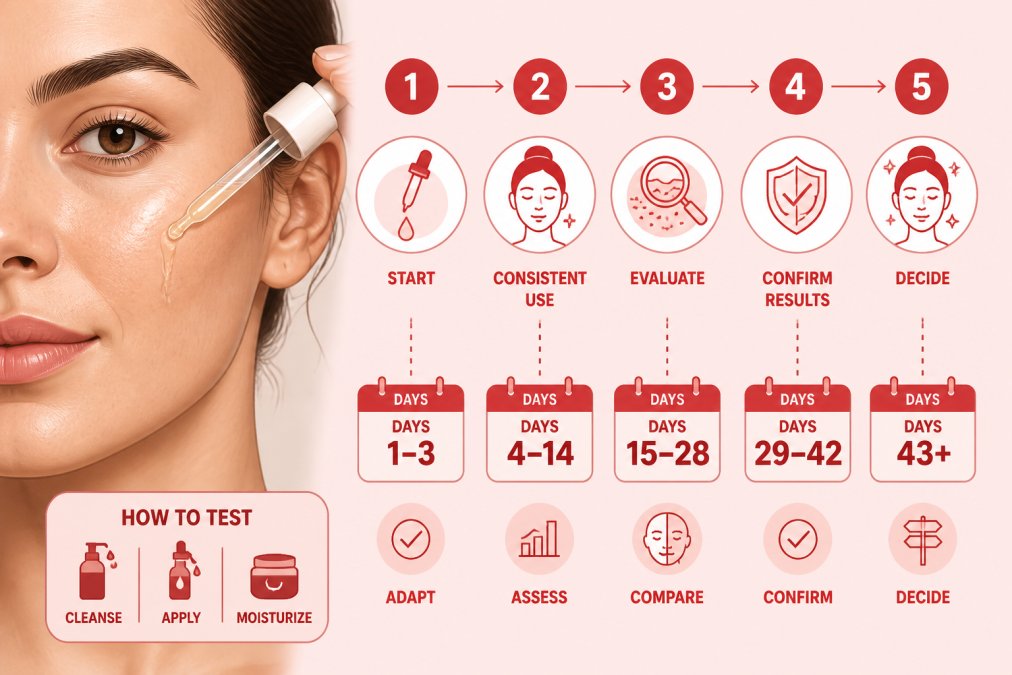
For most products, you need a minimum of four weeks to evaluate effectiveness. This covers roughly one full skin cell turnover cycle. During this time, your skin goes through its natural renewal process, and you'll see how the new product performs across a complete biological cycle.
However, four weeks is the floor, not the ceiling. For active ingredients like retinoids or exfoliants, eight to twelve weeks is more realistic. These ingredients work gradually, building efficacy over time. Judging a retinoid after four weeks often leads to premature switching because the real benefits, improved texture, reduced fine lines, enhanced firmness, develop over months, not weeks.
For serums and hydrating products, four to six weeks is typically sufficient. These ingredients work more immediately. If a hydrating serum isn't improving your skin's moisture levels or glow after six weeks, it's probably not the right fit.
The adjustment period is crucial to understand. In the first two weeks, your skin may show temporary irritation, congestion, or dryness as it adapts to new ingredients. This doesn't mean the product is wrong. It means your skin is processing something new. Push past this phase before deciding the product doesn't work. If irritation intensifies rather than subsides by week three or four, that's a signal to stop.
Purging vs. Reaction: The Critical Diagnostic
This is where most people get confused and abandon products too early. Understanding the difference between purging and a genuine allergic reaction determines whether you should persist or switch immediately.
Purging happens when a new active ingredient accelerates skin cell turnover. Your skin brings existing congestion to the surface faster than it normally would. You see breakouts, but they're concentrated in areas where you typically break out. The breakouts appear within the first one to two weeks and gradually improve as your skin adjusts. Purging is temporary and actually a sign that the ingredient is working.
Reaction is your skin's negative response to an ingredient it doesn't tolerate. Redness, burning, intense itching, or hives appear and worsen over days rather than improve. Reactions often appear in areas where you don't normally break out. A reaction means the ingredient is incompatible with your skin, not that your skin is adjusting.
The timeline distinguishes them. Purging peaks around week two and improves steadily. A reaction intensifies or stays severe. If you see breakouts in week one that are clearing by week three, you're purging. If you see spreading irritation or worsening redness after week two, you're reacting.
Sensitive skin complicates this. If you have a history of reactive skin, purging can still happen, but it will be milder. You might see one or two breakouts rather than a cluster. The key is whether the irritation is localized to areas you normally break out in and whether it's improving over time.
How to Transition to New Skincare Products Safely
Switching skincare brands doesn't mean replacing everything at once. A gradual transition protects your skin barrier and gives you clear data about which products are working.
Start by introducing one new product at a time. If you're switching serums, replace only the serum. Keep your cleanser, moisturizer, and any other products the same. This approach isolates the variable. If your skin reacts, you know exactly which product caused it. If you swap five products simultaneously, you have no way to identify what's working and what isn't.
Apply the new product every other day for the first week. This gives your skin time to acclimate without overwhelming it. In week two, move to daily use. By week three, you'll have enough data to know if your skin tolerates the new product. If irritation appears in week one, slow down further, use it twice a week for an additional week before increasing frequency.
Patch test if you have sensitive skin or a history of reactions. Apply a small amount to your inner arm or behind your ear for three days. If no irritation appears, it's likely safe for your face.
When Switching Makes Sense: A Framework for Smart Decisions
Not every urge to switch is worth acting on. Use this framework to decide whether switching skincare brands actually serves your skin.
| Decision Factor | Switch | Stay |
|---|---|---|
| Persistent breakouts after 6 weeks | Yes | No |
| Visible improvement in fine lines | No | Yes |
| Adjustment period irritation (weeks 1-3) | No | Yes |
| No results after 3-6 months | Yes | No |
| Seasonal skin changes | Maybe | Maybe |
| Boredom with current routine | No | Yes |
| Severe dryness or barrier damage | Yes | No |
| Clear, stable, improving skin | No | Yes |
Frequently Asked Questions
How long should I test a new skincare product before deciding if it works?
Most active ingredients require 4-8 weeks to show measurable results because skin cell turnover takes time. Retinoids, vitamin C, and peptides typically need 6-8 weeks to demonstrate efficacy. However, irritation or adverse reactions usually appear within 1-2 weeks. Give new products at least 4 weeks of consistent use before switching, unless you develop signs of a true allergic reaction (severe redness, hives, swelling) rather than normal adjustment purging.
What's the difference between skin purging and an allergic reaction?
Purging is a temporary adjustment period where existing congestion surfaces as breakouts, typically lasting 2-4 weeks and appearing in areas prone to congestion. It's common with exfoliants and retinoids. A true reaction causes immediate redness, itching, burning, or hives that worsen over days, not improve. If symptoms intensify after 3 weeks or spread to new areas, stop the product. Patch testing on your jawline for 3-5 days before full application helps distinguish between the two.
Is it worth switching from a routine I'm happy with to try something new?
Only switch if your current routine no longer delivers results, your skin has changed (aging, sensitivity, seasonal shifts), or you want to simplify. Consistent routines allow active ingredients to work, switching frequently prevents your skin barrier from stabilizing. A high-performance serum with proven ingredients like copper peptides and bee venom can replace multiple products, reducing cost and complexity.
How do I know if my skincare routine actually isn't working?
After 8-12 weeks of consistent use, your routine isn't working if you see persistent breakouts in the same areas, worsening texture or dryness, lack of glow despite hydration, or no improvement in fine lines or firmness. Also assess whether you're using active ingredients correctly, layering order, concentration, and frequency matter. Before switching brands entirely, try adjusting frequency, layering method, or adding a complementary product like a targeted serum before abandoning a routine that may just need optimization.