
Table of Contents
- Are Peptide Serums Worth It for Fine Lines? The Honest Answer
- How Peptide Serums Work on Fine Lines and Wrinkles
- Peptide Serum vs Retinol: Which One Should You Choose?
- How Long Does Peptide Serum Take to Work?
- How to Use Peptide Serum for Best Results
-
Finding the Best Affordable Peptide Serum
- 1. Identify the peptide by name, not by category
- 2. Check where the peptide sits in the ingredient list
- 3. Look at what supports the peptide
- 4. Evaluate the packaging
- 5. Calculate cost per use, not cost per bottle
- 6. Ignore claims that cannot be verified
- A note on formulation uncertainty
- Where this leaves the affordable question
- Conclusion: Who Should Buy a Peptide Serum?
- Frequently Asked Questions
Last Updated: October 7, 2026
Are Peptide Serums Worth It for Fine Lines? The Honest Answer
Yes, with conditions. Are peptide serums worth it for fine lines? For early, shallow lines and for skin that needs firmness and hydration support, a well-formulated peptide serum can help. For deep-set wrinkles, a serum alone will not erase them.

Here is the nuance most guides skip: peptides are support ingredients, not resurfacing agents. They signal your skin to do more of what it already does. That means realistic expectations matter more than the bottle.
Below, we break down what peptides actually do, how they compare to retinol, how long results take, and who should skip them entirely.
How Peptide Serums Work on Fine Lines and Wrinkles
Peptides are short chains of amino acids, the same building blocks that make up proteins like collagen and elastin. When applied topically, they act as signaling molecules: they tell your skin cells to ramp up repair activity.
Collagen and elastin give skin its bounce. As production slows with age, skin loses firmness and fine lines appear. Peptides aim to nudge that production back up.
Copper peptides, including GHK-Cu, are among the most studied in this category. They are also the type we formulate with at Vampire Tx, combined with Hyaluronic Acid and Bee Venom.
What the Research Actually Shows
Topical peptide research is promising but limited. Many studies are small, use different concentrations, and test different peptide types, so results do not always transfer to every product on the shelf.
What the evidence supports most consistently:
- Improved appearance of skin firmness and elasticity with consistent use
- Better hydration and supple skin texture
- Support for the skin barrier and repair processes
What it does not support: claims that a peptide serum will eliminate deep wrinkles. No topical product does that without in-office procedures.
A common mistake is judging a serum after two weeks. Peptide signaling is cumulative, and the visible payoff builds slowly.
Peptide Serum vs Retinol: Which One Should You Choose?
Most guides frame this as a fight and pick a winner. That framing is wrong. Peptide serums, retinoids, vitamin C, and plain moisturizers work through different mechanisms, carry different evidence strength, and solve different problems. The right question is which one matches your skin, your goal, and your tolerance for irritation.
Here is the comparison by evidence, benefits, drawbacks, and use case, the version most articles skip.
| Factor | Peptide Serum | Retinol (Retinoid) | Vitamin C | Moisturizer |
|---|---|---|---|---|
| Primary mechanism | Signaling support for collagen, elastin, barrier | Accelerates cell turnover, remodels skin over time | Antioxidant, supports collagen, brightens | Occlusives and humectants reduce water loss |
| Evidence strength for fine lines | Moderate but limited; small studies, varied peptides and concentrations | Strongest of the group; decades of clinical use | Moderate; best for tone and photodamage, mixed for lines | Indirect; smooths the look of lines by plumping skin |
| Typical visible change | Firmness, suppleness, hydration | Texture, tone, line depth over months | Brightness, even tone, some firmness | Temporary smoothing, reduced tightness |
| Irritation risk | Low | Higher, especially in the first weeks | Variable; can sting sensitive skin | Very low |
| Best use case | Sensitive skin, daytime, barrier support | Stubborn texture and deeper lines, evening | Dullness, uneven tone, antioxidant defense | Everyone, every routine, every day |
| Results timeline | Gradual, builds over months | Weeks to months | Weeks for tone, months for firmness | Immediate, lasts hours |
| Layer with others | Yes | Yes, with care and buffering | Yes, but watch for stacking acids | Yes, always last |
What this means in practice. If your main concern is deep-set lines and your skin tolerates it, a retinoid does more heavy lifting than any peptide serum. If your skin stings, peels, or flakes on retinol, peptides are the sensible substitute, not a lesser one. If dullness and uneven tone dominate your mirror, vitamin C earns its place before peptides do.
The stacking question. A common routine that works for many people: vitamin C in the morning, peptide serum layered under moisturizer and sunscreen, and a retinoid at night two to four times per week. Peptides and retinoids do not cancel each other out. The real risk is irritation from stacking too many actives at once, not from the combination itself.
Where peptides genuinely win. They are the rare active that plays well with almost everything, works in daylight, and does not demand a purge period. For someone building a first anti-aging routine, or rebuilding after a retinol setback, that compatibility is the whole point.
How Long Does Peptide Serum Take to Work?
Most people notice better hydration within days and firmer-looking skin over eight to twelve weeks of consistent use. That timeline is a general expectation, not a guarantee, since results depend on the peptide type, concentration, and your skin.
Signs you are on track:
- Skin feels more supple and smooth after cleansing
- Makeup sits more evenly over fine lines
- A slightly more lifted, refreshed appearance around the cheeks and eyes
If nothing changes after three months of daily use, the formula or the concentration is likely the issue, not your skin.
How to Use Peptide Serum for Best Results
Apply peptide serum to clean, slightly damp skin morning and evening, then follow with moisturizer and sunscreen. That order matters: damp skin absorbs better, and sunscreen protects the collagen you are trying to support.
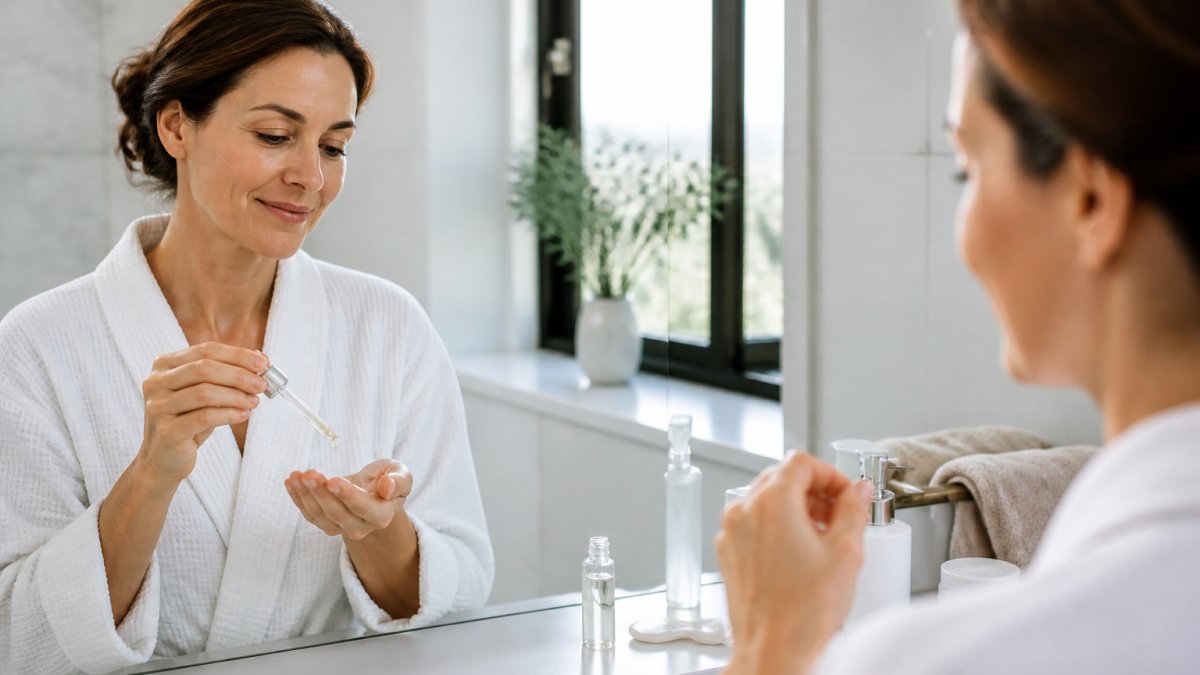
A simple routine that works:
- Cleanse gently and pat skin damp
- Press three to four drops of peptide serum into face and neck
- Layer moisturizer to seal in hydration
- Apply sunscreen every morning, no exceptions
- Add retinol at night only if your skin tolerates it
What most guides miss: more serum is not better. Three to four drops covers the full face. Using half a bottle per week wastes product and does not speed results.
Finding the Best Affordable Peptide Serum
"Affordable" and "effective" are not opposites in skincare, but they are not the same thing either. The label tells you more than the price tag does, if you know what to look for. Here is a practical framework for evaluating any peptide serum before you buy.
1. Identify the peptide by name, not by category
"Peptide complex" tells you nothing. A well-formulated serum names its peptides: copper tripeptide-1 (also written GHK-Cu), palmitoyl tripeptide-1, palmitoyl tetrapeptide-7, acetyl hexapeptide-8, matrixyl, and so on. Named peptides let you research the specific evidence behind them. Unnamed blends make that impossible, which is usually the point.
2. Check where the peptide sits in the ingredient list
Ingredients are listed in descending order of concentration until the list drops below one percent, after which order is flexible. If a peptide appears after preservatives, fragrance, and a long tail of botanicals, the amount is likely minimal. That does not automatically make the product useless, some peptides are effective at very low concentrations, but it does mean you cannot assume the front-of-bottle claim reflects the formula.
3. Look at what supports the peptide
A peptide alone is a thin formula. Look for supporting ingredients that do complementary work:
- Humectants like glycerin, hyaluronic acid, or panthenol for hydration and plumping
- Barrier ingredients like ceramides, niacinamide, or cholesterol
- Antioxidants like vitamin E or green tea extract
- Preservation and packaging that protect the formula from light and air
4. Evaluate the packaging
Peptides are fragile. Airless pumps, opaque bottles, and sealed droppers protect them better than wide-mouth jars or clear glass. A jar of peptide cream that you dip your fingers into exposes the formula to oxygen and bacteria every time you open it.
5. Calculate cost per use, not cost per bottle
A $15 serum you use three drops of twice a day may last two months. A $60 serum with the same usage pattern costs roughly four times as much per day. Divide the price by the number of days the bottle realistically lasts. That number, not the sticker price, is what you are actually paying for the results.
6. Ignore claims that cannot be verified
"Clinical strength," "dermatologist recommended," and "pharmaceutical grade" are marketing language, not regulated terms. Concentration percentages, when disclosed, are more useful. When they are not disclosed, treat the claim as unproven.
A note on formulation uncertainty
Two serums can list the same peptide and perform differently. Concentration, pH, penetration enhancers, and the rest of the formula all matter. This is why serum-specific evidence is thinner than evidence for peptides as a category: a study on one finished product does not transfer to another. When you cannot find product-specific data, lean on the label quality and the supporting ingredients as your best proxy.
Where this leaves the affordable question
A well-labeled, well-packaged peptide serum can be a genuinely good value. Read the label first, then decide whether the price is justified.
For deeper wrinkles, no serum replaces professional treatment. For fine lines and early prevention, a well-formulated peptide serum is one of the most cost-effective steps you can add, provided the label holds up to scrutiny.
Conclusion: Who Should Buy a Peptide Serum?
Peptide serums make the most sense for people in their late 20s through 50s dealing with early fine lines, loss of firmness, or sensitive skin that cannot handle retinol. If you have deep-set wrinkles, expect support rather than transformation.
The real question is not whether peptides work in theory, but whether the bottle in front of you is formulated well enough to deliver. That is the gap we built Vampire Tx to close: copper peptides and bee venom in a single, affordable step, no luxury markup attached.
Frequently Asked Questions
Are peptide serums worth it for fine lines?
Peptide serums can improve the appearance of fine lines by supporting collagen production and boosting hydration. Clinical evidence shows moderate results, especially for early signs of aging. They work best with consistent daily use over 8-12 weeks. If you have deep wrinkles, peptides alone may not be enough; combining them with retinoids or in-office treatments delivers better outcomes. For prevention and mild fine lines, a quality peptide serum is a worthwhile addition to your routine.
Can you use peptide serum with retinol?
Yes, you can use peptide serum with retinol, but timing matters. Retinol increases skin turnover and can cause irritation, while peptides support repair and hydration. Many dermatologists suggest using them at different times: peptides in the morning and retinol at night, or alternating days. This reduces the risk of irritation while letting both ingredients work. Always introduce one product at a time and patch test first, especially if you have sensitive skin.
How long does it take for a peptide serum to work on fine lines?
Most people see initial hydration improvements within 1-2 weeks. Visible changes in fine lines typically appear after 8-12 weeks of consistent use. Collagen remodeling takes time, so patience is key. Results depend on formulation, concentration, and your skin's condition. Products with copper peptides like GHK-Cu may show faster firming effects. Take photos every four weeks to track subtle progress that's hard to notice day to day.
Are copper peptides better than other peptides for skin?
Copper peptides, especially GHK-Cu, have strong research backing for wound healing and collagen stimulation. They may support skin firmness and repair more effectively than some carrier peptides. However, other peptides like Matrixyl and Argireline target different concerns: Matrixyl for collagen, Argireline for expression lines. The best choice depends on your primary goal. Many effective serums combine multiple peptides or pair copper peptides with hydrating ingredients like hyaluronic acid for broader benefits.
If you are tired of juggling three products to get firmness, hydration, and barrier support, Vampire Tx Face Serum combines copper peptides, hyaluronic acid, and bee venom in one bottle for $19.00. Get started with Vampire Tx and build a simpler routine that supports your skin every day.